Aggressive Notes: Taipei Parking Battles 台北停車:瘋了嗎?

I previously posted about passive aggressive notes in Taipei related to parking.  But this post couldn’t really be described as “passive aggressive” as it is pure aggression from start to finish:
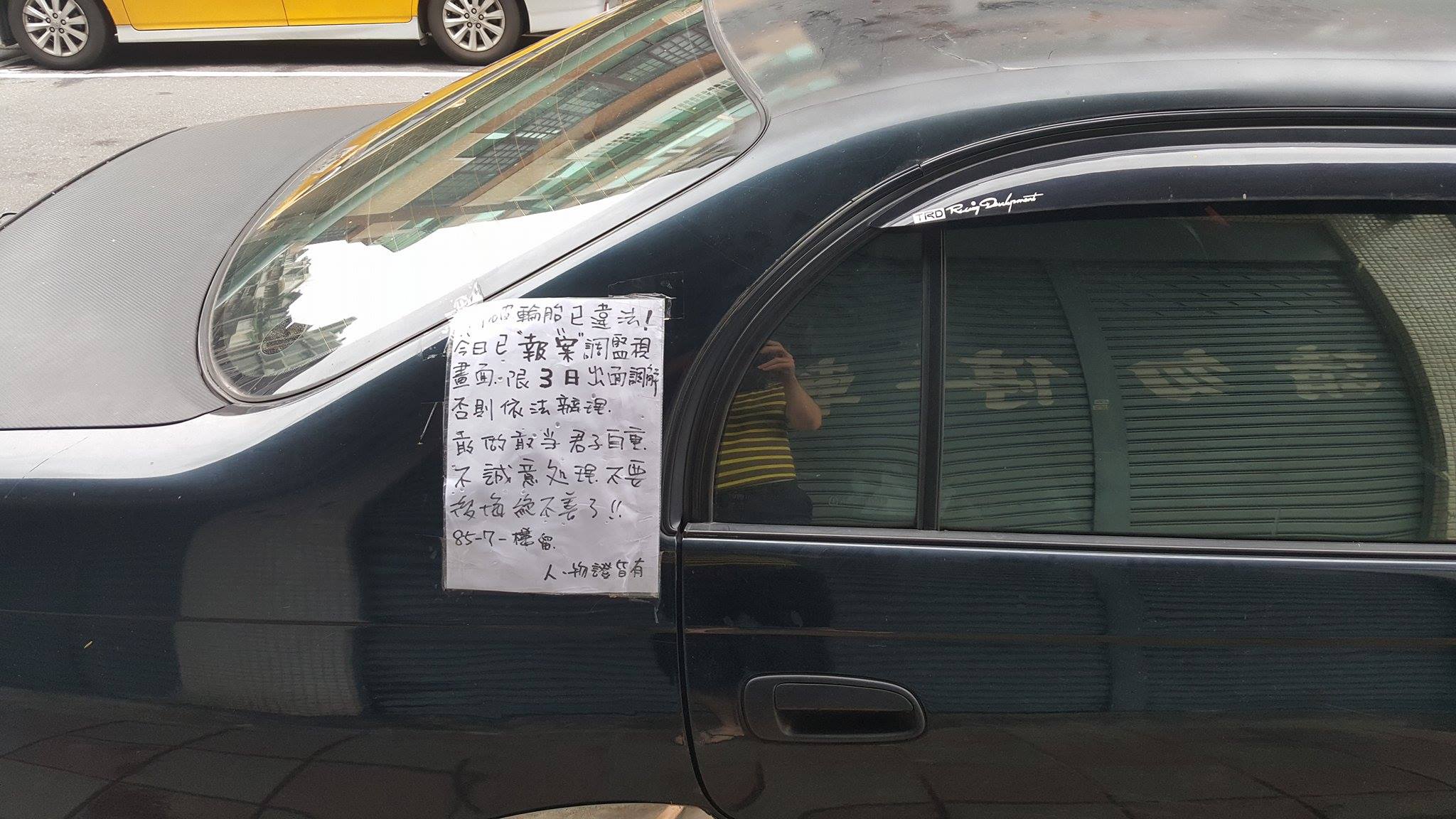
14971119_10102906933370999_1446554131_o

You can see the shutter of a shop in the reflection of the car window, which reads 「請勿停車」, which means “Please do not park”. And here’s a close-up of the note:
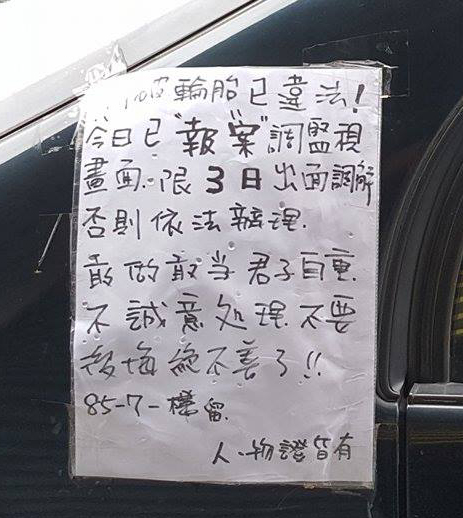
14971119_10102906933370999_1446554131_89o

The note reads:

「刺破輪胎已違法! 

今日已”報案”調盤視 

畫面.限3日出面調解

否則依法辦理.

敢做敢君自重.

不誠意理.不要

後悔絶不善!

85-7-留

人·物證皆有」

Or in English:

By puncturing my tires you’ve already broken the law! Today I already went to report it as a crime and we’ve gone through the CCTV footage. I’ll give you three days to own up and come to an agreement, otherwise I’ll proceed through legal means. If you had the guts to do it, have the guts to behave like a gentleman about it. If you don’t deal with this honestly don’t regret the unpleasantness that comes!

85-7-Liu

We’ve got witnesses and evidence

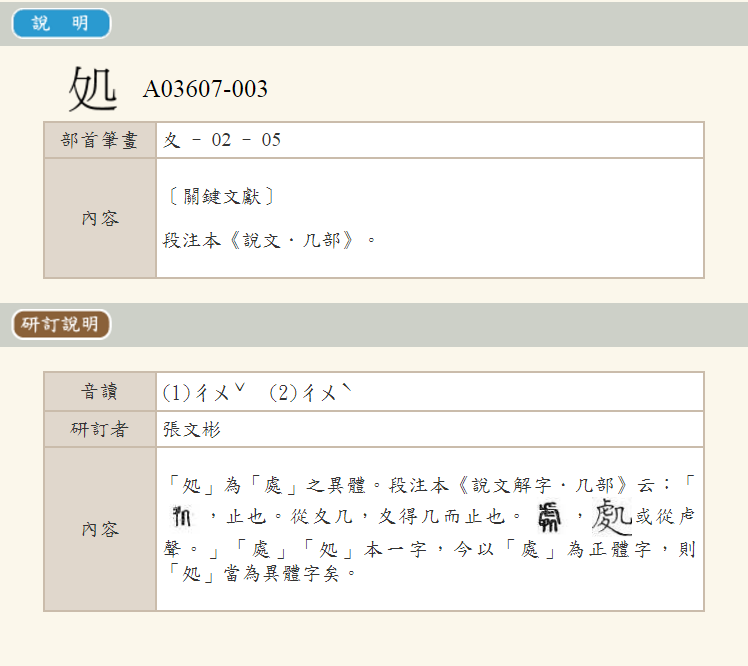
It’s interesting that the author used the shorthand 「当」 for the character 「當」, which is the same as the simplified version of the character used in China. They also use the shorthand 「処」chu3, which is a variant which differs from both the standard version of the simplified (处)and traditional character (處):
chu3
Taken from the Ministry of Education Variant Dictionary, a useful resource when you come across characters that don’t seem to exist in normal dictionaries.

This explains that 「処」 is a variant of 「處」(as is the simplified character).

I don’t know what the situation is exactly and if the car belongs to the person who put the “no parking” sign on their shutter or someone else. I’m also not sure what the 「85-7-留」 means, thought it might be a license plate or a reference to a law, but it doesn’t seem to be the latter. Let me know if you know!
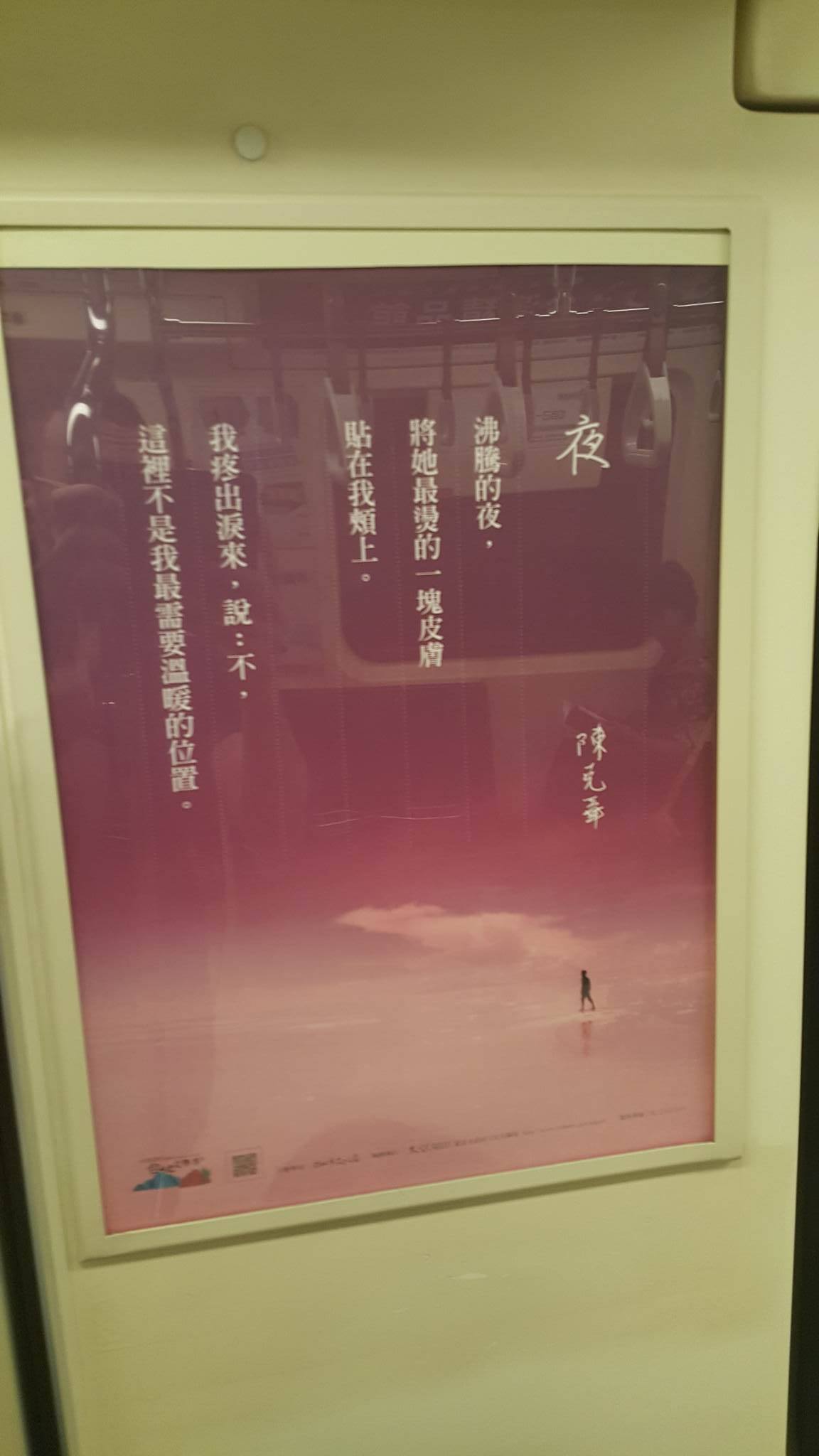
MRT Poetry: Chen Ke-hua’s ‘Night’ 捷運詩句:陳克華的「夜」

14114710_10102698113856979_1574419286_o

Another day, another opportunity to lean over someone to take a photo of the poem on the MRT behind them. This one’s by Chen Ke-hua and I thought it was pretty appropriate for this humid summer night.

夜     Night

沸騰之夜,     The Simmering Night,

將她最燙的一塊皮膚     Lays the most scalding piece of its skin

貼在我頰上。     Against my cheek.

我疼出淚來,說:不,     I cry tears of pain and say, “No”,

這不是我最需要溫暖的位置。     This isn’t where I’m most in need of warmth.

Chen was born in 1961 and was born in Hualien in Taiwan, although his family were originally from Wenshang in Shandong. After graduating from Taipei Medical University he started his career in medicine. In 1997 he studied at the Harvard Medical School, returning to Taiwan in 2000. He now works at the Department of Ophthalmology of Taipei Veterans General Hospital and as an assistant professor at the medical school of National Yang Ming University. As well as his medical career, he’s also a poet, an author, a painter and a photographer.

Update: Tea Trademarks in Taiwan

13833016_10102631328146079_23349234_o

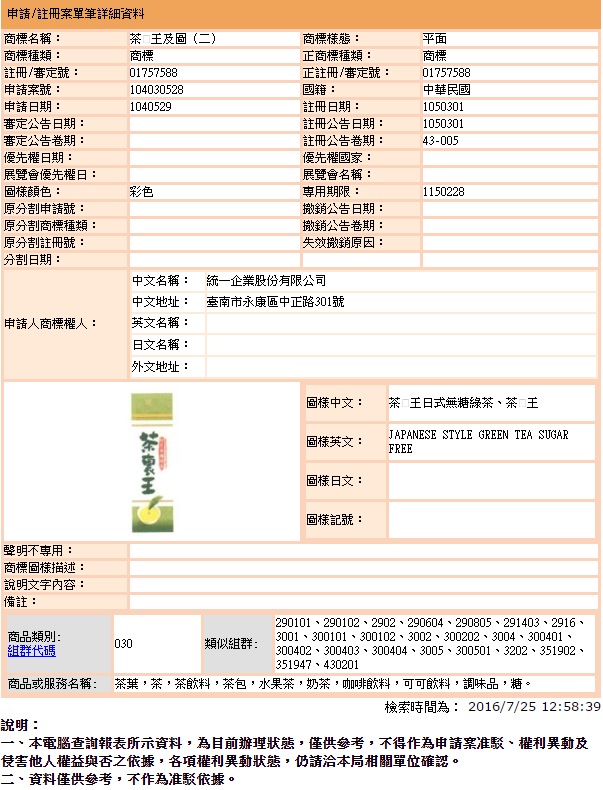
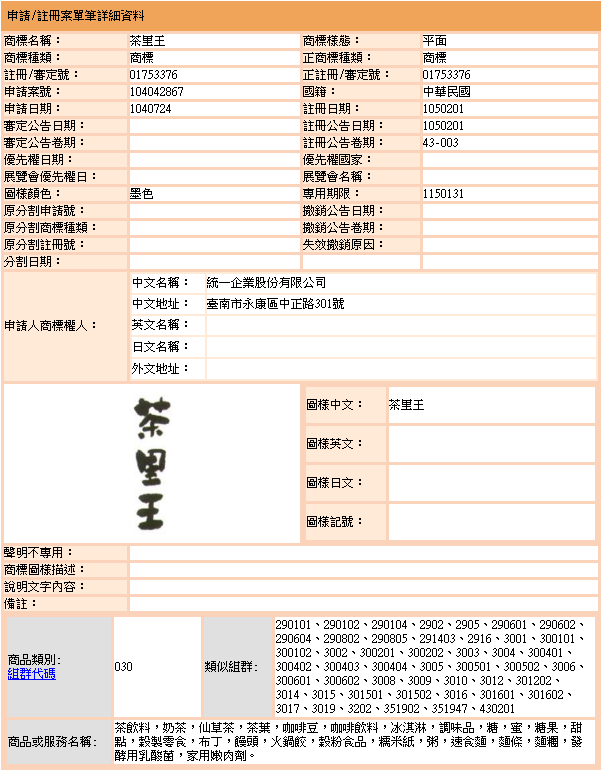
I recently posted about a trademark lawsuit in Taiwan, involving Uni-President Enterprises Corporation’s tea brand 「茶裏王」 and 「阿里王 Ali One」. I pointed out in the post the difference in the second characters of each brand name. However, I recently checked the trademark database in Taiwan and found that Uni-President has registered both 「茶裏王」 and 「茶里王」 as can be seen below:

chaliwang.png

You’ll notice, amusingly enough, that the character 「裏」 doesn’t even show up on the Taiwan Intellectual Property Office trademark search website – and is displayed as just a blank box. The missing character is pictured in the image, however.

chaliwang2

This makes the judgement I previously mentioned a little more understandable, given that two out of the three characters are the same (even if they have different meanings). You’ll also notice that the product ranges to which the second trademark is applied is broader than the first.

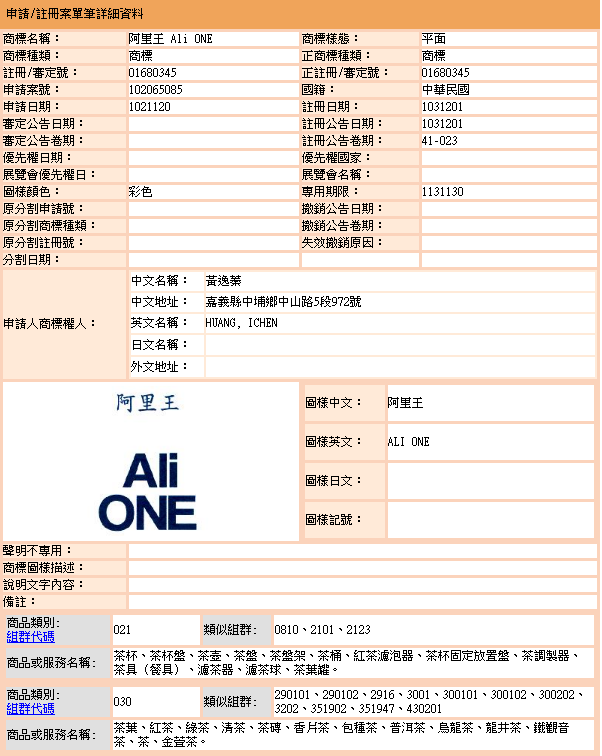
Here’s the registration for 「阿里王」:

AliOne

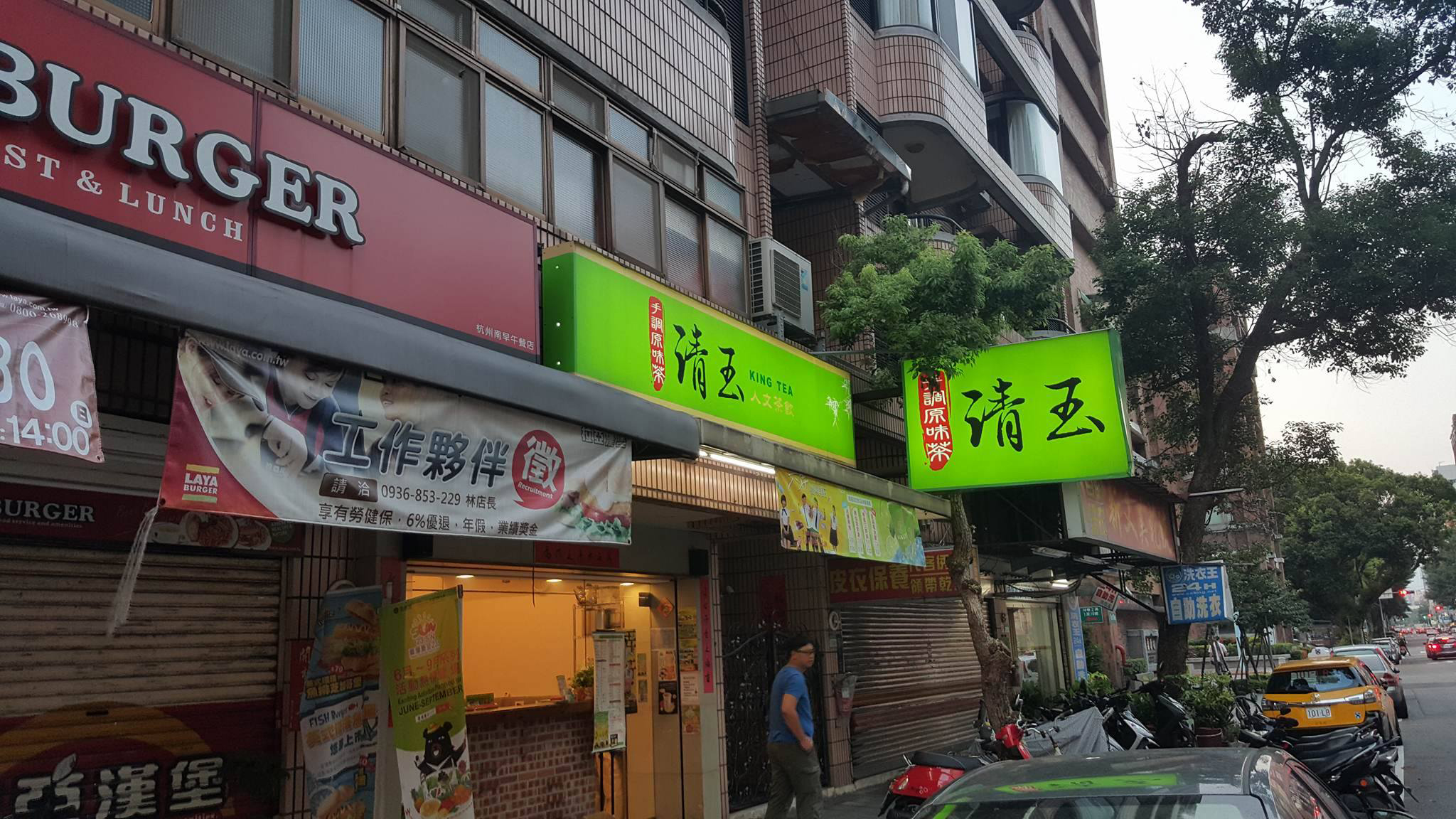
Interestingly, the English translation for 「茶裏王」, “King of Teas”, doesn’t seem to be a registered trademark. So many companies and brands adopting similar English names is allowed, like the one at the head of this article (King Tea).

Tea Trademarks and Chinese Variants: King of Teas/Ali One Tea Dispute 茶裏王/阿里王商標大戰

13730546_10102616344538349_1668283995_oI thought that the recent trademark dispute between Taiwanese tea brands 「茶裏王」 (King of Tea) and 「阿里王 Ali One」 that resolved in favour of the former was interesting because two characters 「里」 and 「裏」 have been seen by the Taiwan Intellectual Property Court as the same character.
「茶裏王」 was launched in the early 2000s by Tainan-based international food conglomerate Uni-President Enterprises Corporation, while 「阿里王 Ali One」 was launched in 2014 by a woman called Huang Yi-zhen (黃逸蓁).

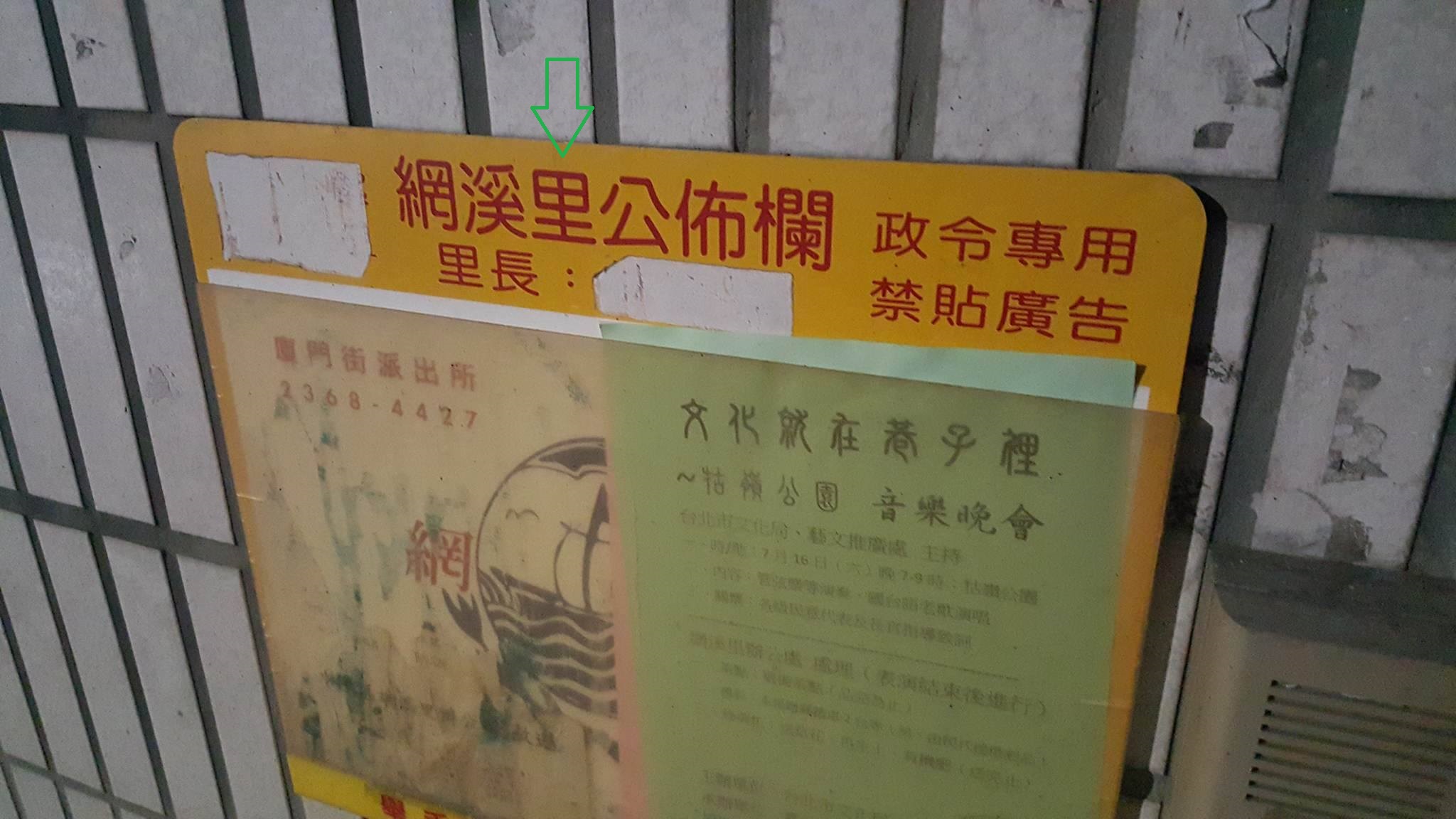
The name 「茶裏王」 translates to “King of Teas” because the 「裏」, a common variant of the character 「裡」, means “among” or “in”  – so it’s literal meaning is “among teas a king”. 「阿里王」 however, just uses 「里」 as a phonetic particle as part of 「阿里」which alludes to 「阿里山」 (Alishan National Scenic Area) – which itself is a transliteration of the Tsou (鄒) aboriginal name for the area “Jarissang”. In fact, although 「里」 means “in” in simplified Chinese, in which it is used in place of 「裡」 and 「裏」, in traditional Chinese, it is only used as a unit of measurement (approx 500m) and for an administrative unit under township (neighborhood/village). Each district in Taipei has an individual li, as shown in the street sign below:

13709674_10102616934336389_2086533172_o

While the 「王」 in 「茶裏王」 means “King”, the 「王」 in 「阿里王 Ali One」 appears primarily to be a transliteration of the English word “one”, hence the product’s English name. A similar example is the 「旺」 in 「旺旺集團」, which is anglicized using the English word “want”, to give you the Want Want Holdings Group – the company at the center of the media monopoly protests in Taiwan and my former employer. However, there’s also a sense that the 「阿里王 Ali One」 trademark is also playing off the use of the word 「王」 as both a transliteration and for its literal meaning as “king”, i.e. King of Ali (referencing Alishan, an important tea-growing area in Taiwan). So the case for the third character is not as strong as that for the second, in my unqualified view.

Thus, the Intellectual Property Court finding as quoted by this report on the trademark case would seem to be incorrect:

智財法院認為,「茶裏王」、「阿里王Ali ONE」商標都是用於茶葉商品,第二個字皆有「里」字,第三個字皆為「王」字,對消費者而言近似程度高,加上「茶裏王」商標使用久、知名度高,因此應給「茶裏王」較大的保護,今判統一勝訴,智財局須撤銷「阿里王Ali ONE」商標註冊,全案仍可上訴。

The Intellectual Property Court found that the trademarks “茶裏王” (King of Tea) and “阿里王 Ali One” are both used to market tea products, and that the second character in each is “里” while the  third characters in each are both “王” (King), so they are very similar for consumers. In addition because the “茶裏王” trademark has been in use for a long time and is very well-known. because of this, “茶裏王” should have greater protection, so Uni-President Enterprises Corporation won the case today, and the Taiwan Intellectual Property Bureau rescinds the trademark granted for “阿里王Ali One”, although the case is still subject to appeal.

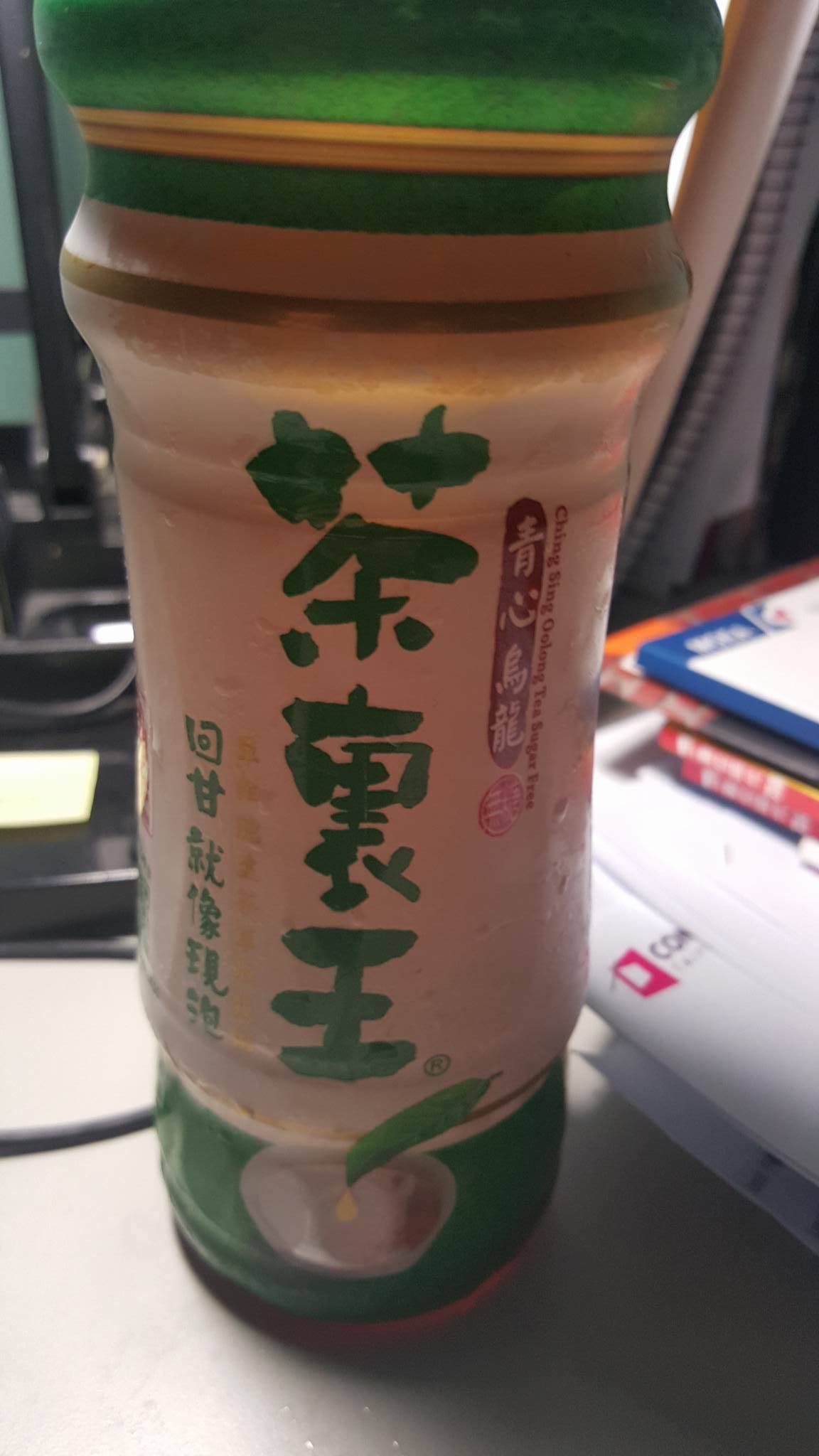
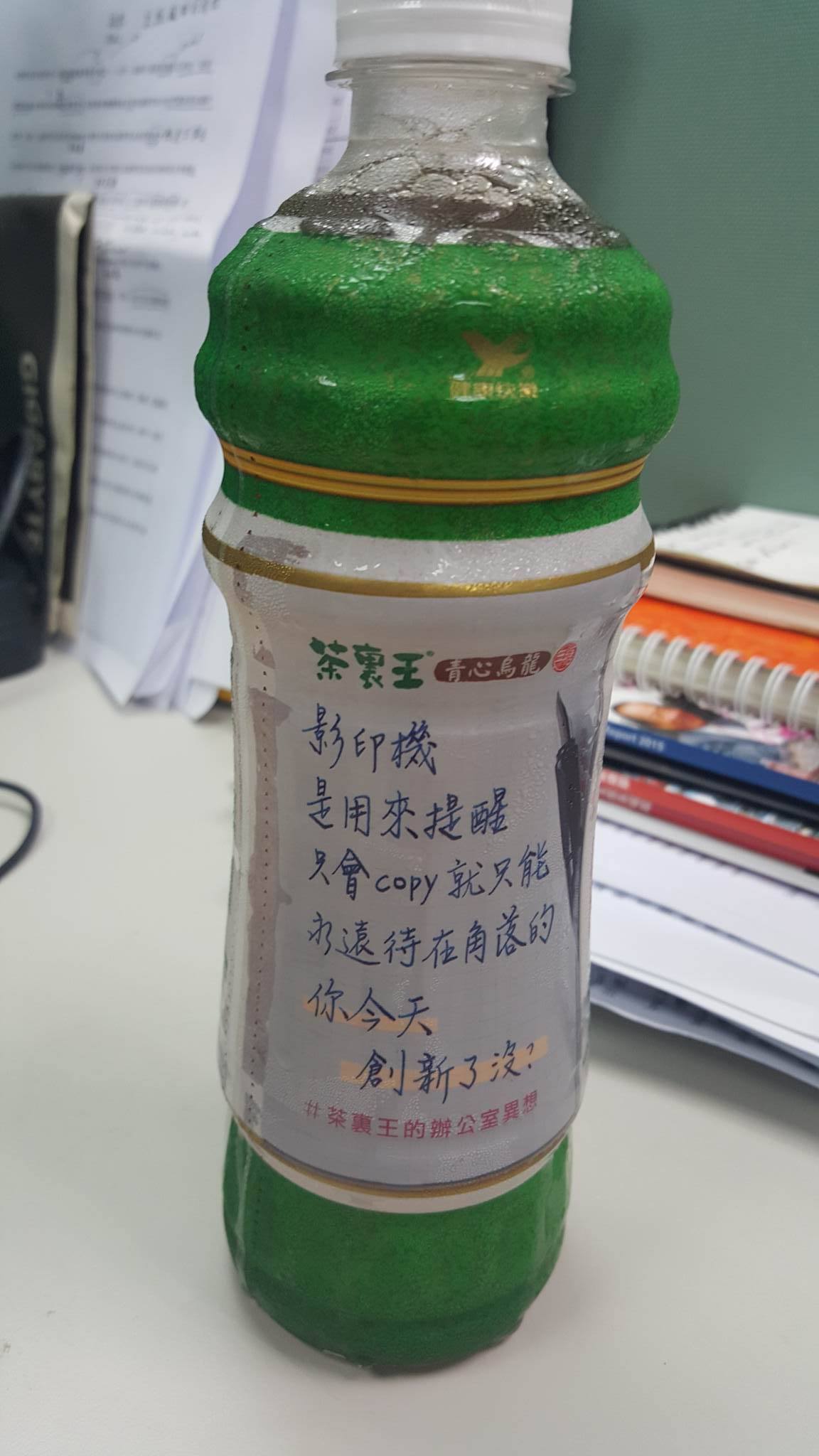
The 「茶裏王」 bottles have recently been featuring thought-for-the-day style “profundities” (note the use of speech marks) such as the one below, which I thought was particularly apt to go with this post:

13702265_10102616344643139_102669126_o

Photocopy machines are used to remind you

That if you only copy

You’ll stay in the corner forever

Have you done something innovative today?


MRT Poetry: ‘Mental Image’ by Yan Ai-lin 捷運詩句:顏艾琳的「意想圖」

There’s still plenty of nice poetry to be found on the MRT when you’re out and about in the city.

13709612_10102606285766209_1770654764_o

意想圖

Mental Image

木訥之僧在街口肅立

An unaffected taciturn monk stands solemnly on the corner

他伸出雙手

With both hands outstretched

十指化為一隻缽

His ten fingers forming an alms bowl

化著路行者的隨緣心

Shaping the casual kindness of passersby

Yan Ailin was born in 1968 in Tainan. She graduated in history from Fu Jen Catholic University. She is a poet, a lecturer and an author.

N.B.  Variants of 「缽」 featured in a previous post.

When I asked what a 「莊腳面」 looks like…

So after yesterday’s post on the Taiwanese term 「莊腳面」 ‘country bumpkin face’  chng-khabīn – I got inundated (read: I got like two comments) by information from Taiwanese friends trying to explain what kind of faces they are.

One 天龍人* friend used two alternative ways of representing the term in Chinese: 「增咖面」(phonetic rendering) and 「樁腳面」. He suggested any of the actors from shows in the 8pm slot on TV, like 《娘家》(Mom’s House), 《世間情》(Love) and 《嫁妝》(Dowry):

Niangjia
ordinary-love
hqdefault

He also said it could be applied to non-Taiwanese people, and put forth Susan Boyle and Adele!? as two examples from the UK. He said that it’s because they look “dated”.

Another friend said it was a synonym for the expressions 「土」 (rustic) and 「台」 (folksy with Taiwanese characteristics).

A1250534134

*「天龍人」 is a term generally used in Taiwan to refer to people from Taipei, suggesting that they are elitist and look down on others. It takes its origins in the term “World Nobles” (Japanese: 天竜人 Tenryūbito) from Japanese manga One Piece and literally means “Heavenly Dragon Folk”, snobby arrogant elites who serve as the world government in the manga (hmm, snobby, arrogant, who would that remind you of…). 

Let me just note here that I don’t endorse judging people on the basis of whether they are from an urban or rural environment and this is all meant in a lighthearted way.

Revisiting an Old Post on 「莊腳面」(庄腳面) Taiwanese for “Country Bumpkin Face”

I noticed a spike in views of one of my old posts, looking at the use of the term 「莊腳面」 in Wu Nien-chen’s Human Condition series of plays, which were the topic of my master’s thesis. When I googled the word again, the following news story from yesterday came up several times, suggesting it might be the reason people were looking for a definition of the term:

zhuangjiaomian

The article is entitled “Chang Jung-fa explains that even if you look like a bumpkin, you can still be a flight attendant” and seems to be largely a puff-piece. I just pictured a group of country bumpkins eager to become flight attendants eagerly googling what the term means.

Here’s the definition I previously posted:

莊腳面 chng-khabīn, basically means that someone’s face looks like they’re from the countryside, or a bumpkin. It’s not always used in the negative, as it can imply innocence or directness and honesty too, I guess it depends on what your opinion on people from the countryside is. I found an answer on Yahoo which gives quite a good explanation of 莊腳 and other terms, although I’m not sure if the first three are still used in Taiwanese:

莊頭 進入村莊前緣的地方 The beginning of the village
莊內 村莊中心的地方 The main part of the village
莊尾 村莊末端的地方 The tail end of the village
莊腳 chng-kha 村莊外圍偏遠的地方 The places on the outer margins of the village
(I know, inception-like quotations within quotations)

So, this would make 莊腳 the bumpkin of bumpkins, as even the people in the village think he’s a bit rustic.

You probably noticed too, that the Chinese article I cited uses the character 「庄」, not the 「莊」 I used in my original post. 「庄」 is actually a variant of 「莊」(village)  according to the Ministry of Education Dictionary. I thought this was interesting, as I think that CNA used the variant in order to be sure people knew to read it as Taiwanese. As with most of my theories, I’ve got little proof, but would be eager to find out if anyone knows of similar examples.

It’s relatively unusual for newspapers not to put the Chinese translation in brackets after a Taiwanese phrase is used unless it’s extremely common, which might explain why so many people were Googling the word. If you’re Taiwanese you can comment on how common this word is. On the other hand it could just have been lots of foreigners who came across the Chinese article and didn’t know what it meant.

Feel free to comment below or message me with any strange or startling Taiwanese phrases you come across or even with sketches the typical 「莊腳面」.

Shamelessly Ashamed: 「不恥」or 「不齒」 Part 3

I previously posted two blog posts  looking at how 「不恥」 and 「不齒」 are used as homonyms to mean “shame” in Ruan Ching-yue’s short story ‘The Conman’ (translation available here) and in A Dictionary of Maqiao by Han Shaogong (review available here), despite the former actually meaning “unashamed”. This suggested that most Taiwanese now use 「不恥」 rather than 「不齒」 , while reading 《斷代》 by writer Kuo Chiang-sheng however, I discovered a counterexample:

13078157_10102468049637519_1647047856_o

In this sentence, 「不齒」 is used as follows:

…展現的仍是令開放的同類不齒的無知與無奈…

… showing still the ignorance and helplessness that is such a source of shame for those gay people who are open…

The book is really good so far and I’d definitely recommend it.

Addicted to ‘Addicted’《上癮》上癮了

So I watched Addiction/Addicted or 《上癮》 the gay-themed Chinese drama that got banned recently and… I thought it was great for a Chinese drama. If you don’t want spoilers skip down past the first photo. Although let’s face it, spoilers aren’t really a concern with formulaic but fun dramas.

Albeit it’s a little bit problematic that stalking, rape, kidnapping and violent jealousy are treated as normal (and almost comical) ways in which the couple finally get together. If I hadn’t seen a lot of straight Chinese dramas along similar themes, I would think this was an attempt to demonize the gay community, but in other series that don’t feature gay themes and even in the straight relationships featured in the series, bat-shit crazy is seen as a normal expression of love. Although it may be seen as encouraging unhealthy behaviour in relationships, let’s face it, this is a soap opera, so drama is par for the course. It was therefore a little bemusing to see the couple waking up as lovers the night after the kidnap before – but let’s not try and find too many life lessons here and explore some of the language instead! My friend told me the book is worth a read and is a bit of a tear-jerker, but can’t find it on online bookstores.

cha2

So this may all be common knowledge for those of you who studied Chinese in Beijing, but for learners in Taiwanese, it can raise a few eyebrows. Here we see the phrase 「每次都找我的茬」「茬」(chá) could be replaced by 「麻煩」, as the phrase means  “He’s always trying to make trouble for me”.

The second word 「慫」 (sǒng) seems to mean “I couldn’t be arsed arguing with you, so you can have it your way” – a super long explanation for one tiny word, lol.
怂

The next term 「奴家」 isn’t really a slang term, I just thought it was funny to hear in the context of banter between two bi-curious guys in a Chinese drama

nujia

Dahai uses 「奴家」(a humble self-referential term used by women) as a jokey self-reference.

Below we’ve got the old classic 「咋了」 which just means 「怎麼了」

za

Happy to get an earful from any Beijingers who take issue with any of the interpretations here or just be nice and leave some more Beijing slang in the comments section.

Why is Taiwan’s FSA serving up beef? 「端出牛肉」的由來

06437933-782b-4fb0-9a73-8fb6c50c3ee5_f_faec872c89

So, the Financial Supervisory Commission is serving up beef according to this China Times article…

獎勵Fintech專利 金管會端牛肉

The Financial Supervisory Commission is serving up beef (putting its money where its mouth is) to Incentivize Fintech Patents

What I love about Chinese and particularly news headlines in Taiwan is that the most random references in the world can become rooted in the language forever after (well according to what I could find online).

According to an online forum, this is a reference to the borrowing of a line from a 1984 Wendy’s ad by unsuccessful presidential candidate Walter Mondale (Yeah, I know, who the fuck knew?) during his campaign against incumbent Ronald Reagan in 1984. Mondale asked Reagan, “Where’s the beef,Mr. President — where’s the beef?”.

Here’s the ad for those under 30:

In Taiwan this was adapted into a popular saying, “serving up beef”  is to take direct action or put your money where your mouth is.

If this really is the origin of the phrase, it just goes to show how influential US culture has been in Taiwan.

On a side note, if you want a brilliant satirical read on this theme, you should check out Rose, Rose, I Love You (《玫瑰玫瑰我愛你》)by Wang Chen-ho (王禎和)either in Chinese or in translation. It is set in a village in Taiwan as they prepare for the imminent arrival of US troops, coming for R&R from the Vietnam war during the 1960s and the author pokes fun at the blind worship of US culture in Taiwan at that time, with all the cultural misapprehensions that go alongside it.