Investing in the Taiwan Stock Market

If you’re an ARC/APRC holder and interested in investing in the Taiwanese stock market, first set up a bank account if you don’t already have one. If you do, take your passport and ARC/APRC to the securities company associated with your bank. This will generally be in a different location/building from your bank branch.

Just Google your bank’s name with 「證券」 behind it. Here are some of the most popular ones:

  • 富邦證券
  • 永豐金證券
  • 元大證券
  • 兆豐證券
  • 國泰綜合證券

When you arrive, you’ll be asked if you were referred there, but if not, they will assign someone to come and ask you some questions regarding your income and how much you’re interested in investing, as well as whether you only want to invest in Taiwanese stocks (委託) or if you want to invest in overseas stocks as well (複委託), although you’re not allowed to invest in your home country’s stocks.

You’ll be asked if you have a bank account with the associated bank, and then you’ll have to sign a bunch of forms (bring your chop if you started your bank account with a chop). They will then teach you how to use the bank’s associated app, and will ask you if you want a paper or electronic booklet to record your trades (the Taiwan Depository & Clearing Corp. app for Android or Apple).

You’ll be given login information for both your trading app and the TDCC app once your account has been registered.

A few things to note:
– If you’re buying individual stocks, remember to use 「零股下單」 as opposed to 「證券下單」, as the latter works in units of 10,000.
– You will only receive roughly 71% of any dividends issued, due to a flat tax rate for “non-residents” (this will be refunded as part of your tax bill the following year if you’re retroactively considered resident for tax purposes), and an NHI deduction of 8%.
– Stocks listed alongside the letters TPE are on the Taiwan Stock Exchange Corporation (TWSE), and are integrated into Google Finance should you wish to collate information on individual stocks (price/high52/low52/change/closeyest), so if you wanted a Google Sheet cell to display the price of the Yuanta Top 50 ETF (0050), you would write the following: ==GOOGLEFINANCE(“TPE:0050”, “price”)
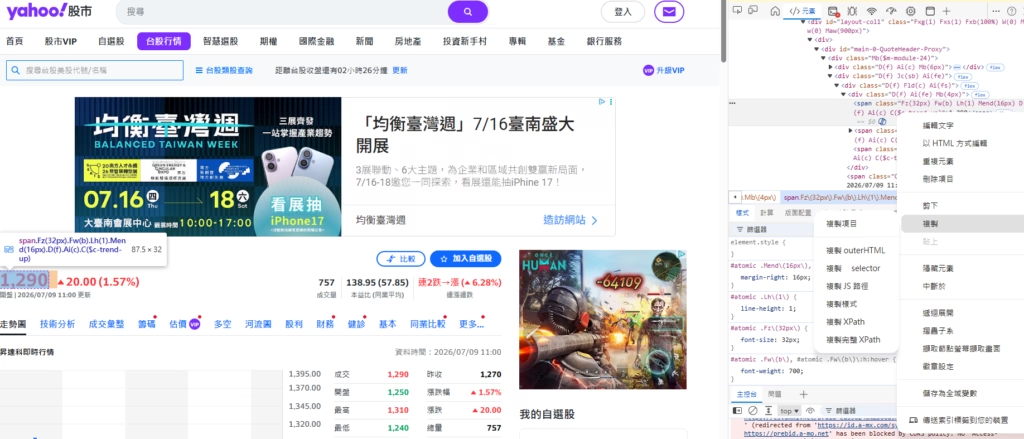
– Stocks listed with the letters TWO are listed on the TPEx or the Taipei Exchange, for SMEs and smaller companies, and over-the-counter trades. These are not integrated into Google Finance, so you’ll have to either find the information yourself, or integrate it with the following: =IMPORTXML(“https://tw.stock.yahoo.com/quote/3491.TWO”, “//*[@id=’main-0-QuoteHeader-Proxy’]/div/div[2]/div[1]/div/span[1]”) where the former part is the stock’s Yahoo page, and the latter is the X Path.

Click “Inspect, find the number you want, click copy and then select X path”

For more information and interesting tidbits about the investment landscape in Taiwan, there’s a great Mandarin-language podcast called Gooaye.

This should not be considered financial advice and is just for information purposes.


Weaponizing Variants Against the Taiwan People’s Party in Taiwan #莮

「#莮」 is all over Taiwan social media networks at the moment, but what does it mean? Well, it’s kinda complicated, but essentially it represents the popular imagination of the stereotypical male Taiwan People’s Party supporter, along with a few buckets of misogyny, pretension, pro-PRC sentiment, and being a mummy’s boy thrown in.

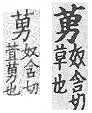
「莮」 itself is part of an archaic word, referring to a kind of grass, but it is now being borrowed to point to the supposedly “weedy” kind of men who support the TPP.

Some people are also conflating it with 「草食男」 from the Japanese 「 草食男子」 (そうしょくだんし), men who are not interested in adhering to traditional male stereotypes in terms of being ambitious at work or dating women, but I think this is maybe just because of the similarity in the visuals of the characters.

There are a selection of 「莮」 posts, but do your own exploring on Threads and Facebook too:

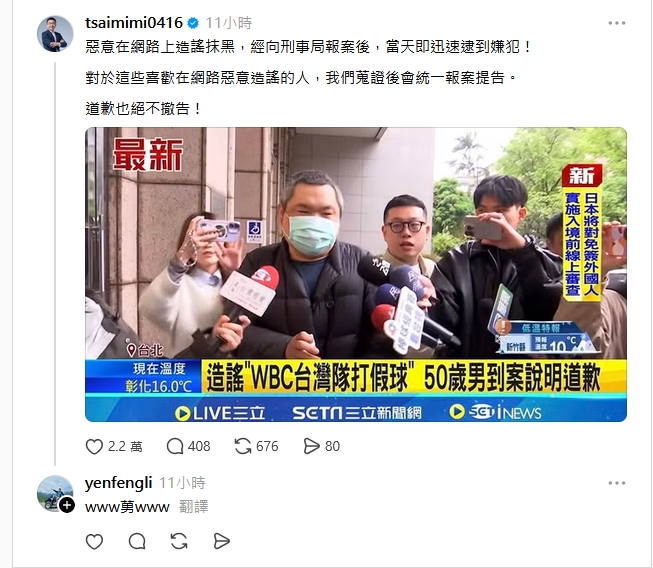
A post of a news segment on the public apology of a 50-year-old man questioned by police for spreading false information online, alleging that the World Baseball Classic was rigged. Someone has commented underneath www莮www

The majority of posts seem focused on supporters of the blue(KMT)-white(TPP) coalition, but there are also some posts that focus on personality:

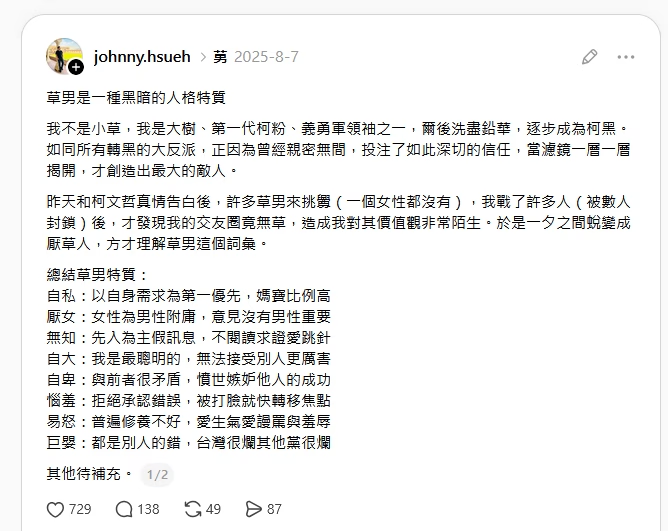
A recovering Ko P fan who has now seen the light describes 莮 or 草男 characteristics:
Selfish: Their own needs are their first priority and a large percentage are mummy’s boys
Misogyny: Women are an accessory for man, and their opinions are not worth as much as those of men
Ignorant: They will read the first bit of misinformation they don’t try to fact check anything and will go on like a broken record.
Self-important: They think they’re the smartest person in the room, and can’t admit that anyone might be better than them.
Insecure: A contradiction with the above, they get raging with envy at the success of others
Shamed into Anger: They refuse to admit mistakes, and will change the topic of conversation if you show them up.
Quick to anger: They’re generally not very well brought up, they’re quick to anger and will cuss people out and shame them.
Big babies: Everything is someone else’s fault, Taiwan sucks, and every other party sucks.

Ko Wen-je will give me an apartment and a girlfriend


Gen Z I’m coming for you! Spoiling Taiwanese Slang

Fans of the blog will know that I enjoy exploring new slang, thereby making it not cool anymore. Thanks for the explanations here. Up on the victim list today are the following:

暈爛 yūnlàn basically expresses that you love something so much, you’ll find it hard to stop. But literally means that you’ll get so dizzy from something that you get sick, or allow yourself to get so dizzy from it that you’ll feel ill.
An example from the wilds below:

“I can’t get enough of single eyelids and dark-framed glasses.”

解/好解/很解/超解 jiě/hǎo jiě/hěn jiě/chāo jiě This is basically “the ick,” something that puts you off someone you originally were into. I feel this is kind of an abbreviation for 「解脫」 jiě​tuō (to be freed of, to be absolved from).
An example from ptt below (2024, I know! I’m so up to the moment.)

Do other girls get the ick from men who get tax rebates?

觸 chù bastardization (what did he say!?) of the English word “true,” used in much the same way as “True that!”
An example from 2025’s version of ptt, Threads (a good source on Gen Z slang):

Post complaining about the lack of political awareness among knitting women on Threads and the verbose reply, “True that!”

普信男 pǔ​xìn​nán A three who thinks he’s a ten (an average-looking guy who thinks he’s god’s gift to women/men). It can also be applied to women if you switch 男 to 女, but that’s no fun.
Fun example from Threads below:

Ko Wen-je: The bailiff was nice to me; 90% of the Taipei District Court bailiffs are Ko Wen-je fans.
Judge: The bailiffs are polite to everyone.
————
The 7-11 clerk smiled at me, he must fancy me.
Post reply: The ultimate incarnation of the average-looking guy acting like he’s god’s gift!

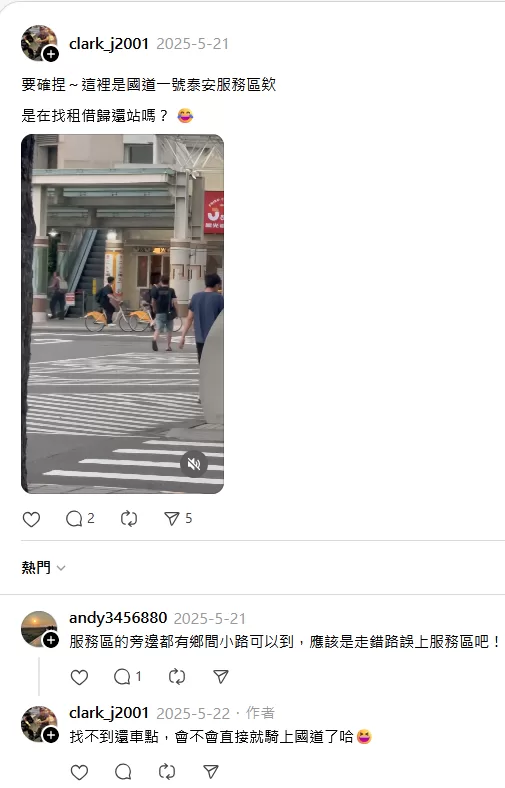
要確捏 / 要確欸 yào què niē​ / yào què ēi The equivalent of a sarcastic “Are you sure about that?” used on the internet to poke fun at people behaving stupidly.
This Threads post shows a few people on YouBikes who appear to be looking for a YouBike stop at a motorway/highway (roads you’re not allowed to cycle on) rest stop in Taiwan.

However, in the replies, someone points out that there is access to a small town via backroads, so they must have just gone the wrong way and ended up at the motorway rest stop.
To be continued?

An excerpt from “The Water Asks From Whence It Flows” by Jian Zhen

This is an interesting book, more akin to a collection of essays. The main thrust of the book is exploring philosophy and observing the world through the medium of flowers, with plenty of references to classical literature (both Eastern and Western canon) along the way. The extract below gives a flavor of the kind of reflections the book contains:

這是無需考證的「現實」,誰也無法倖免的長期痼疾。我們行走世間,真像偷竊生命之果,盜汲智慧之泉的人,無時不刻,要受到現實的緝捕、拷問; 那果實、那泉液,我們妥貼地置於內心的理想之盤上,雙手雙足穩穩地護持著。而現實,這捕快,一眼看出你的破綻,急箭追查。你於潛逃之時,不得不將一盤理想暫託於草叢之中、泥沼之下,待來的歷劫之後,再來取回這稀世之寶。於是,在現實之前,你大膽地坦認:「我毫無理想,不信,你搜!」,這般搜查、尋訪、驗證之後,你的確不是盜者,便判你發還本鄕,侍你起程之日,你不得不驚顫,死神也等你很久了。就算,你尚存餘息,回到埋寶之處,你亦將發現,那泉水已濁、那果實已腐,那托盤已朽,而你鬢已蒼蒼……!你仰天一哭,生命是一場冤枉。

So this is the incontestable “reality,” the chronic disease from which no-one is safe. We walk this world like we’ve stolen the fruit of life and drawn water from the spring of wisdom on the sly and could be seized and interrogated by reality at any time; That fruit and that spring water, we place with care on our inner platter of ideals, dutifully protecting it with all our might. But the bounty hunter that is reality sees your weakness at a glance and shoots an arrow in your wake. As you flee, you have to stow your platter of ideals in some bushes amid swamp waters, until the troubles that lie ahead are behind you and you can return to retrieve these precious treasures. And so, you boldly face down reality, saying, “I have no ideals. If you don’t believe me, search me!” After the searching, probing and questioning, you’re found innocent of the theft and granted leave to return home. As you set off on your journey, you shudder with the realization that death has long awaited you. Although there is still breath in your lungs, as you return to where you buried your treasures, you discover that the spring water has been tainted, the fruit spoiled and the platter rotten, and you yourself are old and gray…! You turn your face to the heavens and cry at the injustice of life.

Efforts to recall KMT legislators in Taipei by appealing to blue voters

If you, like the rest of Taipei, were in Daan Park enjoying the beautiful weather over the weekend, you might have caught sight of protesters with signs calling for the recall of KMT legislator Lo Chih-chiang (羅智強) under the slogan “Reboot Daan” (which is a pretty clever English pun to use).

This close-up below shows more details:

大安強強滾
罷免羅智強!
羅智強 烙跑路上?
強強滾 連署路上!

Daan’s strongman has to go
Recall Lo Chih-chiang!
Lo Chih-chiang running wild in the streets?
The strongman should go, recall petition on the streets!

Continue reading

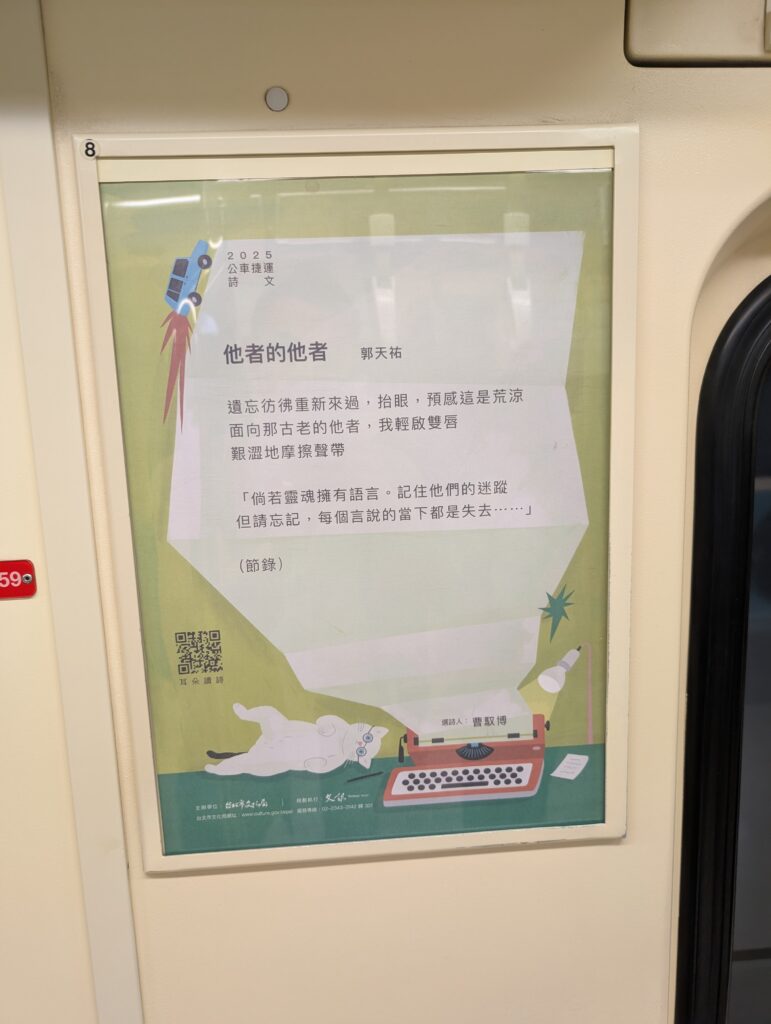
‘The Other’s Other’ by Kuo Tien-yu 郭天祐的「他者的他者」

他者的他者 (節錄)

遺忘彷彿重新來過,抬眼,預感這是荒涼
面向那古老的他者,我輕啟雙唇
艱澀地摩擦聲帶

「倘若靈魂擁有語言。記住他們的迷蹤
但請忘記,每個言說的當下都是失去……

The Other’s Other (Extract)
Forgetting seems to take over again, I raise my eyes with a desolate foreboding
Faced with this ancient other, I gently move my lips
My vocal cords grate together

「Suppose the soul had language. Remember their straying from the path
But please forget that every instant of speech is loss…


「他者」 or “the other” is one of those overused pseudo-intellectual terms in Taiwan (readers are welcome to leave a comment if they have any other nominations) that tend to infect poetry and fiction written by students forced to read too much Derrida or psychoanalytic texts. This normally results in painful attempts at profoundity masking rather empty writing, but for some reason, this extract of a poem captured my imagination one day in the MRT. Perhaps because of the vagueness of language in the original, leaving it up to the reader to piece together (for example, in the English translation, I used the first person, whereas the Chinese doesn’t need to specify). The sentences can also be parsed differently to what I interpreted above.

You can also hear it recited aloud in the video above!

The poet, Kuo Tien-yu, was born in Kaohsiung and studied anthropology at National Taiwan University.

Chicken and duck emojis and the Ko Wen-je corruption case

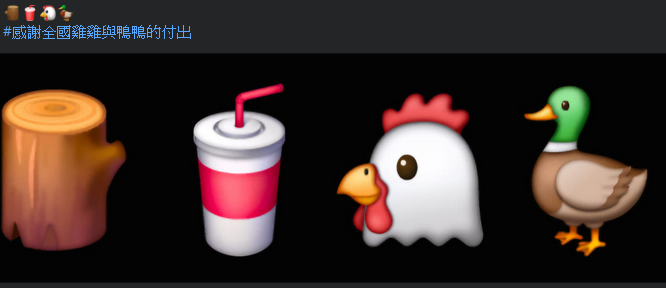
You may have noticed a severe uptick in the use of chicken and duck emojis in recent days all over social media:

🐔
🪿

Why you might ask? 雞 jī and 鴨 yā put together are a homonym of the word 羈押 jīyā for “arrest/detention” relating to Ko Wen-je’s much anticipated arrested (more details here by the brilliant Brian Hioe) for corruption related to the Core Pacific City Mall project.

Facebook user post
IG user post

The first use of the punny homonym is reported to have been the following Facebook Post by 農傳媒 (an agricultural news agency):

https://www.facebook.com/agriharvest.tw/posts/pfbid0kFRyF59WbP9SP2Nm8TPzVnTR7F2u48bhirQDiCXqHdxMtWmdapXZyxmphm8CL8AKl

They used the caption 「雞鴨來了」(Chicken and duck are here! / 羈押來了 The arrest has come)to introduce a new chicken and duck breeding scheme in the wake of Ko’s arrest.

Xiaola style Cantonese biandang stores have also jumped on the opportunity by selling chicken and duck biandangs according to one of my colleagues.