Taiwanese: Little Monkey 猴囡仔 kâu-gín-á

218456_10100190754610009_5702277_o

A few years ago I was digging around trying to find some good Chinese-language podcasts to listen to when I came across an old radio program which had been archived online called 「真情酷兒」(Sincere Queer). As I was working on a piece for eRenlai involving the gay rights movement in Taiwan I got in touch with the presenter of the program Vincent Huang. I ended up interviewing him on his role as an activist for gay and disabled rights as well as disabled rights within the LGBTI community, which you can view below:

Vincent has recently relaunched the program on another platform, branding it 「真情酷兒1.0」(Sincere Queer 1.0). In the 「年夜飯」(Lunar New Year’s Eve dinner) edition, he talks to Taiwanese gay couple He Xiang and Wang Tian-ming (何祥和王天明) – featured in an Isabelle gay wedding cake (喜餅) commercial that got a lot of media attention when it came out- who have been together now for over 30 years. You can watch the commercial below:

The podcast is an interesting look into what it’s like to be an out gay couple in Taiwan, particularly on family occasions. As well as this, at around 7:37 in the download version of the podcast, the presenter uses the Taiwanese word 「kâu-gín-á」 (alternative Taiwanese audio here) in the context of the following Chinese sentence concerning mahjong:

「 雖然他們需要耐心,跟我這個kâu-gín-á打麻將。」

Although they need patience, to play mahjong with a … like me.

I’d heard the word “gín-á” or 「囡仔」 meaning children before, but not with the prefix “kâu” added. This rather appropriately for the time of year, turns out to mean “monkey”. So the term 「猴囡仔」 kâu-gín-á literally means an infant monkey, but is used in an affectionate way to refer to human children, in much the same way as we sometimes refer to kids as “little monkeys”. Here it is used as a form of self-effacement, in that he is referring to himself as relatively young and not as skilled at mahjong as his boyfriend’s mother. This kind of code-mixing between Taiwanese and Chinese is particularly common when it comes to humor, so it’s always good to learn Taiwanese if you want to be able to get the joke in conversations.

If you’ve learned any new Taiwanese expressions that you’d like to share with me over the Lunar New Year break or have any questions you can comment below or contact me.

It’s Art… Don’t Rely on it 「倚靠」跟「依賴」

12625764_10102331362833969_500233106_n

As I was wandering through the Takashi Ohta Paper Museum Expo (being held at Huashan Creative Park Dec 19- Feb 29) I did a double take, when I saw this sign above many of the pieces of art:

12660271_10102331381795969_290275658_n Although I’ve tired slightly of all but the most bizarre Chinglish signage, I thought this one was of note because it can be read as a covert injunction to aspiring paper artists everywhere – “Don’t rely on this kind of work, man.”

To be fair to the Chinglish offender in question, the word 「倚靠」(yi3kao4/ㄧˇ ㄎㄠˋ) in Chinese can mean both “to lean on” and “to rely on”, in the same sense as in English, “leaning on someone” can be extended to mean “relying on someone” (依賴 yi1lai4/ㄧ ㄌㄞˋ). Having had dealings with the kind of people who run these events in Taiwan, I also know that they have about a billion things to do and very little time and money to do them, so we can’t be too hard on them, and where would we be without something to snigger at.

The exhibition was quite cool, I’ll limit myself to posting the scene from Ximen in Taiwan:

12606880_10102331393262989_1237563330_n

Photo taken at exhibition, will remove on request

The rest you’ll have to explore for yourselves.

Comfort Women and Post Election Thoughts

Spotted this sign recently just beside the Zhongzheng Bridge between Yonghe and Taipei:

12606836_10102320459399539_292639309_n

It reads:

The Japanese government should apologize and provide reparations for coercing comfort women during World War II

Created by Wei-Shyue Chang

The subtext of this sign is the recent Taiwanese history textbook controversy over proposed changes to the high school curriculum which pushed for a (slightly) less rosy view of the period of Japanese colonial rule in Taiwan, including using the term coercion when it came to the comfort women issue, Continue reading

Smear before bedtime in Taipei’s 8th electoral district 台北8號選區立委選舉抹黑戰爭

As the legislative and presidential elections draws near in Taiwan, politics is in the air… and on buses and on every street corner.

If anyone missed the first part of the presidential candidate debate on Dec. 27, you can view Part 1 here:

The next one is on Jan. 2 at 2pm.

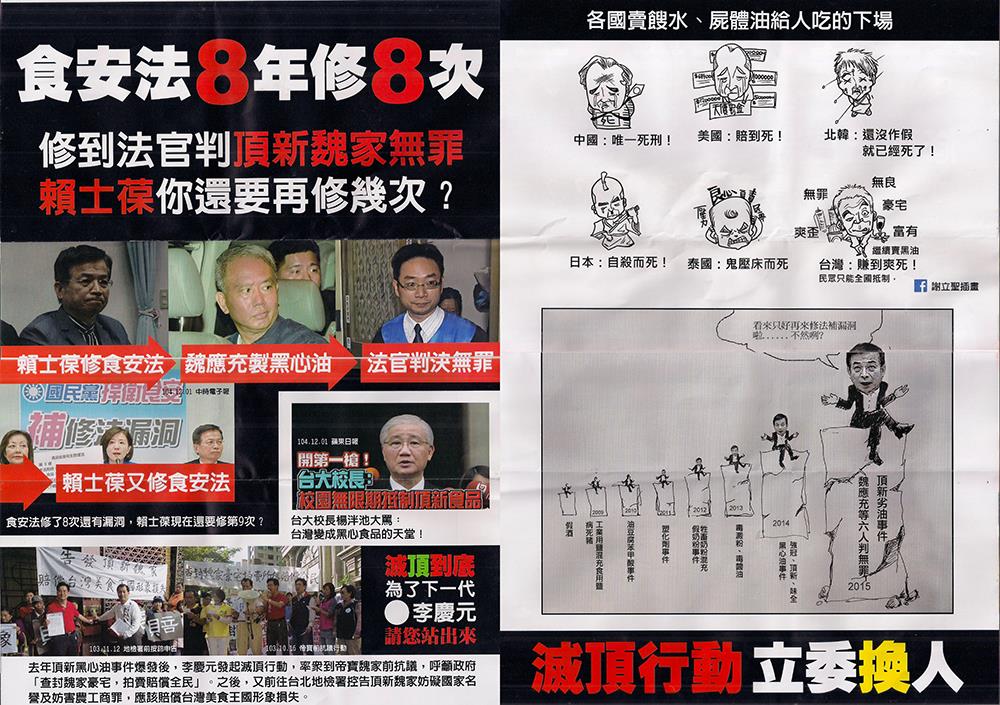
Meanwhile, in District 8, independent Lee Ching-yuan (whose KMT membership was revoked in July due to his opposition to then KMT presidential candidate Hung Hsiu-chu) is gunning for incumbent legislator Lai Shih-bao. He’s released two leaflets with the intention of smearing Lai, both on the basis of whether he’s actually living in the district and his alleged incompetence in dealing with food-safety issues surrounding the Ting Hsin oil scandal.

The first leaflet attacking Lai on the Ting Hsin scandal is below:

12436646_10102292489980479_860031137_o

The first page of the

Continue reading

Passive Aggressive Notes: The Politics of Trash 消極抵抗的紙條:垃圾政治

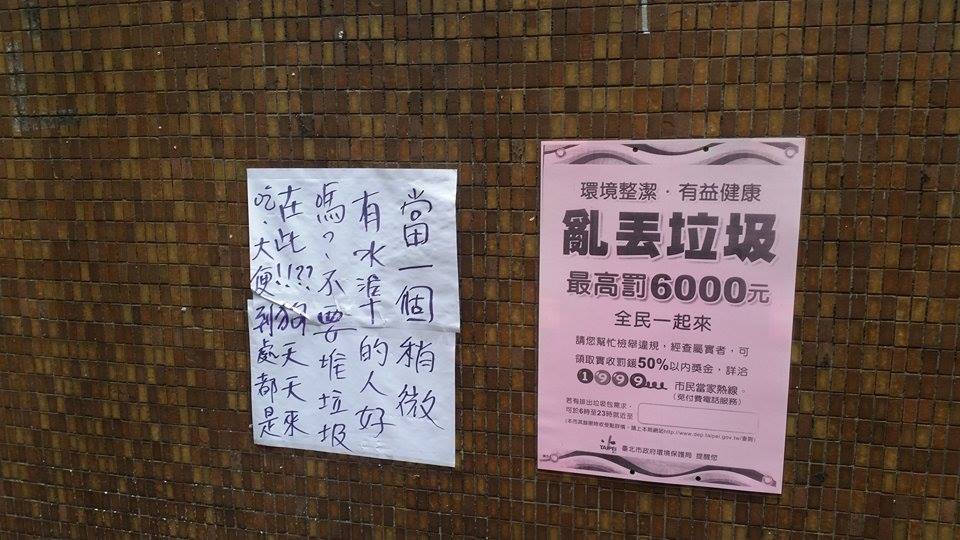
Following on from my past post on the passive aggression that results from the limited parking spaces in Taipei, I thought I’d follow up with a similar post about rubbish, after seeing this sign, on a street in the Daan district of Taipei:

12421676_10102285462398809_1695838554_n

If you live in Taipei you’ve probably seen a whole heap of signs similar to this, but the hysterical tone and the interesting use of punctuation of this particular one made it stand out for me. It reads:

Can’t you have the least shred of decency? Don’t pile rubbish up here!!?? Dogs come here to eat it every day and there is shit everywhere.

If you don’t live in Taiwan you may be unfamiliar with the system. Basically, you have to buy special bags at convenience stores to put rubbish in, then at a certain time  every day the rubbish trucks will come to the end of your street. Unlike in the UK, you

Continue reading

‘Collecting Gods’ by Wu I-Wei 吳億偉的〈撿神〉英文翻譯

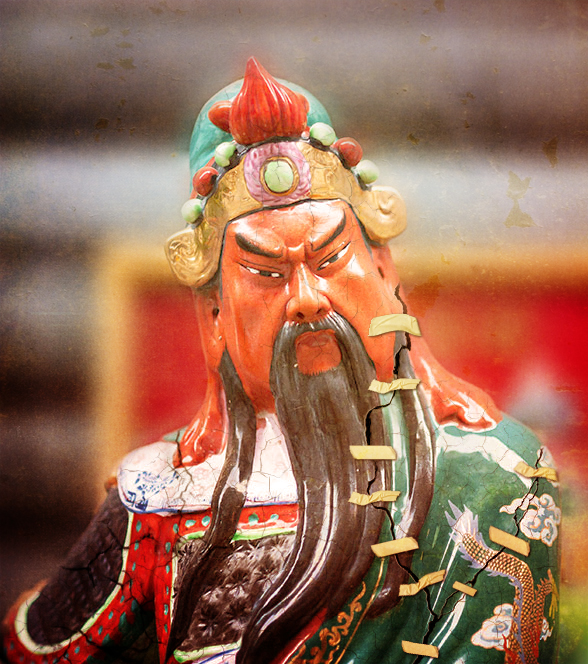
lord_guangWu I-Wei (吳億偉) has won numerous awards including the United Daily Press Literary Award for Fiction, the China Times Literary Award for Fiction and Essays, the United Literature Monthly Literary Award for Fiction, and the Liberty Times Lin Rungsan Literary Award for Short Essays. He published his new collection of essays, Motorbike Days (《機車生活》), in 2014 and is now a PhD candidate at the Institute of Chinese Studies at the University of Heidelberg in Germany and regularly reports the latest German literature news for Taiwanese magazines and newspapers. View an excerpt of a previous translation of his work here. This story, ‘Collecting Gods’, won the Jury Short Story Prize at the 30th China Times Literary Awards in 2007. A slightly different version of the original Chinese story can be found here.
The outside of the embankment was still a deep green in early autumn, the only exception being the cotton-like grey of the miscanthus ears, spreading out in a continuous unbroken strip of their own, the branches appearing a lot softer when in the wind. Amidst the rustling of the leaves and grass, one could hear a clacking sound, like something was rolling toward the riverside. Pushing aside the undergrowth as she went, an old hunch-backed woman dragged a ragged looking old pram along the ground. The frilly lace on it had already gone black and it was full of plastic bottles and sheets of used paper. She looked hesitantly in all directions as she made her way onward, her body lowered to enable her easier access to the ground. The rickety wheels continued to clack as she made her way along the riverbank searching for anything of value.  Behind her ran a line of corrugated iron shacks and across a few loofah trellises, was a small path, cut out among the weeds, leading to a little temple, with a roof of red glazed tiles and mottled yellow walls with several scars, as if marked by lightning. The door was wide enough for a person to pass through with their arms outstretched and the statues of the lords of the three realms – the heavens, the earth and the waters – stood fixed on a platform under the roof, golden crowns on their heads and beards down to their chests, each holding a tablet underlining their divine authority, clothed in official garb of glistening divine gold.

Continue reading

Smearing political rivals in Taipei: Freddie Lim take-down! 林昶佐被林郁方「抺黑」了

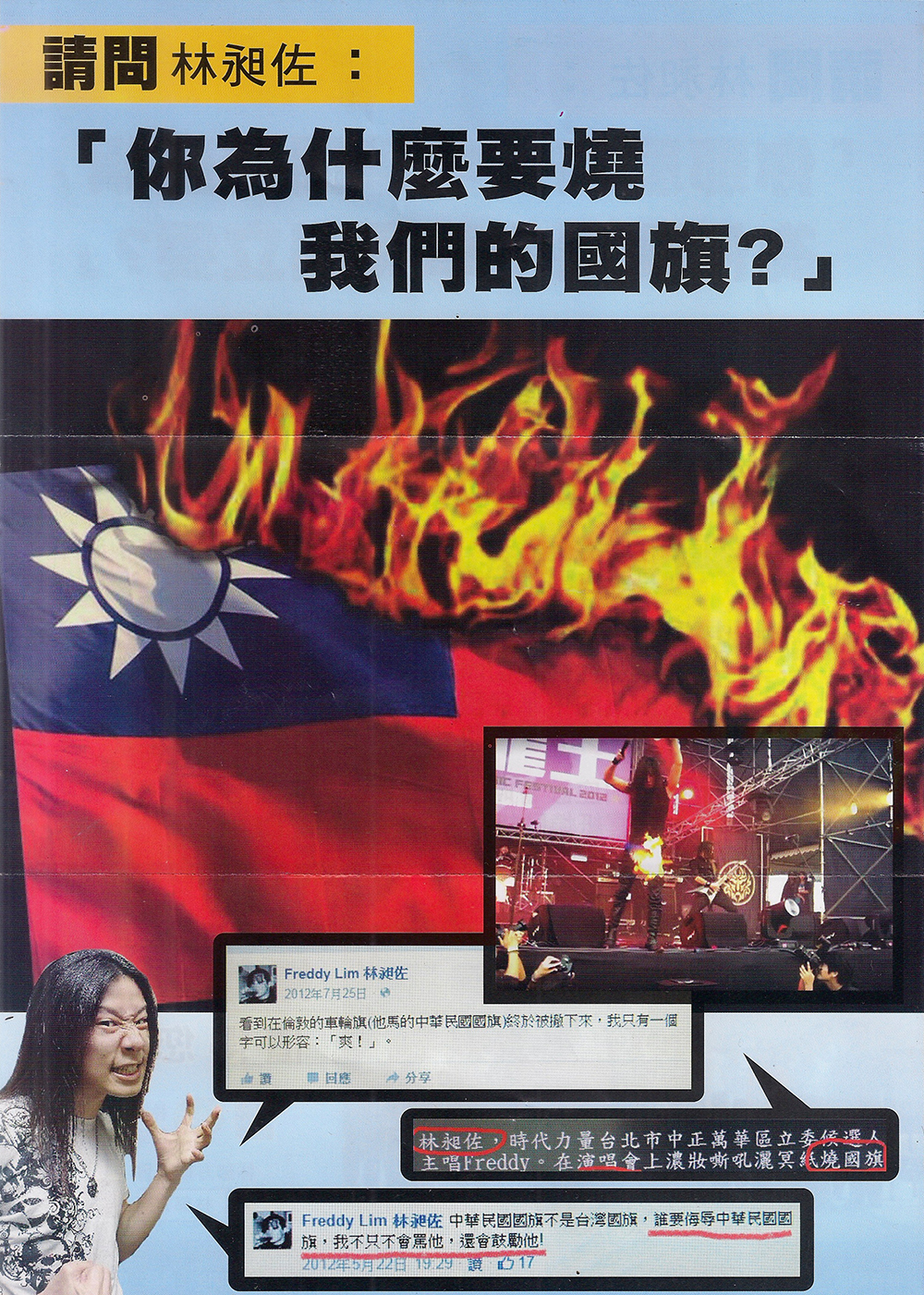
Have you been enjoying the flood of campaign leaflets flowing through your letterbox? I’m living near the boundary between the 5th and 8th electoral districts, so have been getting a range. One particular leaflet released by KMT candidate Lin Yu-fang (林郁方) caught my eye, as the entire thing was dedicated to smearing Lin’s rival for the 5th electoral district of Taipei, Freddy Lim (founding leader of the New Power Party (時代力量) and lead singer of heavy-metal band Chthonic):

whyyouburnflag The front side of the leaflet poses a question to Lim:
I want to ask Freddy Lim: “Why did you burn our national flag?”

Continue reading

Overheard Moments – Taiwanese on the streets 街巷台語

268498_10100230988520929_7221703_n

I love hearing snippets of people’s conversations on the street and it’s always a good opportunity to learn more of a language. I overheard the below exchange about a wedding invite grudge:

Woman: mài (不要) 等(tán) 七(chhit) 年(), mài(不要) 講(kóng抵好(tú-hó只好)  好() 一(chi̍t) 工(kang, 天) 伊(i他) 可能(khó-lêng) 硬(ngē) 掙(chiⁿ), 伊(i他) 都(to) 掙(chiⁿ) 去({k}hì).

Woman: Don’t wait seven years, then one day… Maybe even if she has to force her way in she will still go. She will still go.

á 阮(góan我) a 姊 (chí) 伊(i他)   (也) 無() 可能(khó-lêng) 去({k}hì), 因為(in-ūi) 伊(i他) koh(又) 食素(chia̍h-sò͘). 人(lâng人家) 都(to) 無() 位(ūi) 褪 (thǹg (讓))  hō͘ (給) 伊(i) 坐(chē), 伊(ibeh(要) 去({k}hì) 創啥 (chhòng-siáⁿ做什麼)?

My sister can’t possibly go, because she is a vegetarian. They aren’t able to give her a place to sit, so why would she go?

Man: 無() 位(ūi) 妳(koh(還/又) beh(要) 去({k}hì)?

Man: If there is nowhere to sit she still wants to go?

Woman: 人(lâng人家) 曾XX (姓名) 干單(kan-nā(只有)) 僎(chhôan(準備)) 一(chi̍t) 桌toh  ??? (anninia). m̄是(m̄-sī不是) 阿強 著是(tio̍h-sī就是) 愛(ài(要)) 坐(chē)  主(chú) 桌toh.

Woman: Zeng XX should at least prepare one table for her. Shouldn’t A Qiang in the most important spot.

Feel free to contact me if I’ve misunderstood the above conversation or if you’ve got any Taiwanese words or phrases you hear and want featured on the blog.


‘The Con Man’ by Roan Ching-yue 〈騙子〉阮慶岳

12179644_10153746244263593_3432586_n

He was a con man.

He felt like a cotton-bound paper lantern, panicking that he would be seen through at any moment, giving off, as he was, a glow of affability and affection from every pore, both tantalizing and haughty. After he’d finished a con, he gave his arrogance even freer reign, but he wasn’t normally able to trust his feelings to others. They were his private hoard, a secret love affair, delectable, but not to be shared out loud. Sometimes he felt so stifled that it was as if his insides would rip open in a roar, but then he would use a soothing motherly tone to subdue his organs, bursting as they were with pride-fed excitement, saying, Be good now, I know… but you can’t tell anyone! You can’t tell anyone! You should all be quite aware of that now, shouldn’t you!

The jubilation was like an infant wailing for its mother’s breast, making him feel like a helpless new mother cradling it closer to his chest, rocking it and saying, Don’t cry, don’t cry, come on! Let’s go for a walk to the riverside and see the rainbow. On the street he would be even more cautious, not allowing his arms to fall from his body for even an instant, for fear that the infant inside him would start to wail. Try though he might to contain himself, he wasn’t able to disguise an appearance of self-satisfied mirth and haughtiness, in the drab blur of the crowds, especially with his lantern-like translucent splendor.

His organs would be soothed by the sight of the rainbow and enter into the heavy slumber of sated beasts. However, sometimes the joy he felt was so strong, it would wake him up at night and he would break his taboo by spilling all to his beloved stuffed goose. Like tonight… he couldn’t get images of A out of his head, flowing like restless spirits struggling to emerge from within him, scattered over the countless past months, like colored flags which circle happily in the wind over time, illuminating the lantern case which shrouded him to such an extent that it was as if he would burst into flame any minute.

On nights like this he was left with no other option but to tell the story of A at length to the attentive-looking stuffed goose.

I Lie Because I Love You

Continue reading

Mona Rudao (莫那魯道) Commemorated on NT$20 pieces

coinsMona Rudao, the chief of Seediq tribe during the Wushe incident – a rebellion against Japanese rule which ended in a violent crackdown and Rudao’s suicide, has been commemorated on a NT$20 piece that I was handed at a restaurant yesterday.

Continue reading