Was waiting for a friend at a bookshop and was flicking through a few titles when I saw these volumes about the Sunflower Student Movement. The first one I picked up was this:
The cover looked OK, but my heart sank a little when I saw that the dedication was to Benedict Anderson… and sank even more when the opening sentence featured Marx…
How very politics student circa 1989. I guess that’s why they called it a student movement. The chapters are each written by different people, but it seems quite dense in style and heavy with academic aspirations as opposed to aiming for readability. That said my friend arrived before I was able to get any kind of measure of it.
There were another two as well, and they seemed a little more aimed at the general reader:
Anyone had a read of them or would recommend?
I also read a chapter of Luo Yu-chia’s (羅毓嘉) new book You’re my stove light in dark days (天黑的日子你是爐火). It was a little bit too much navel gazing for my taste, discussing his romance with a Hong Kong man. As Luo is a gay rights advocate the Hong Kong man’s unwillingness to adopt a gay identity is challenging for him. The chapter I read showed him attempting to justify the lack of recognition with humour and by insisting that non verbal markers like wanting Luo to be well fed shows affection where words do not. The romance wasn’t very engaging for me, and I didn’t find the Hong Kong guy very likeable as Luo sees him.
I noticed a spike in views of one of my old posts, looking at the use of the term 「莊腳面」 in Wu Nien-chen’s Human Condition series of plays, which were the topic of my master’s thesis. When I googled the word again, the following news story from yesterday came up several times, suggesting it might be the reason people were looking for a definition of the term:
莊腳面 chng-khabīn, basically means that someone’s face looks like they’re from the countryside, or a bumpkin. It’s not always used in the negative, as it can imply innocence or directness and honesty too, I guess it depends on what your opinion on people from the countryside is. I found an answer on Yahoo which gives quite a good explanation of 莊腳 and other terms, although I’m not sure if the first three are still used in Taiwanese:
莊頭 進入村莊前緣的地方 The beginning of the village 莊內 村莊中心的地方 The main part of the village 莊尾 村莊末端的地方 The tail end of the village 莊腳 chng-kha 村莊外圍偏遠的地方 The places on the outer margins of the village (I know, inception-like quotations within quotations)
So, this would make 莊腳 the bumpkin of bumpkins, as even the people in the village think he’s a bit rustic.
You probably noticed too, that the Chinese article I cited uses the character 「庄」, not the 「莊」 I used in my original post. 「庄」 is actually a variant of 「莊」(village) according to the Ministry of Education Dictionary. I thought this was interesting, as I think that CNA used the variant in order to be sure people knew to read it as Taiwanese. As with most of my theories, I’ve got little proof, but would be eager to find out if anyone knows of similar examples.
It’s relatively unusual for newspapers not to put the Chinese translation in brackets after a Taiwanese phrase is used unless it’s extremely common, which might explain why so many people were Googling the word. If you’re Taiwanese you can comment on how common this word is. On the other hand it could just have been lots of foreigners who came across the Chinese article and didn’t know what it meant.
Feel free to comment below or message me with any strange or startling Taiwanese phrases you come across or even with sketches the typical 「莊腳面」.
I previously posted two blog posts looking at how 「不恥」 and 「不齒」 are used as homonyms to mean “shame” in Ruan Ching-yue’s short story ‘The Conman’ (translation available here) and in A Dictionary of Maqiao by Han Shaogong (review available here), despite the former actually meaning “unashamed”. This suggested that most Taiwanese now use 「不恥」 rather than 「不齒」 , while reading 《斷代》 by writer Kuo Chiang-sheng however, I discovered a counterexample:
In this sentence, 「不齒」 is used as follows:
…展現的仍是令開放的同類不齒的無知與無奈…
… showing still the ignorance and helplessness that is such a source of shame for those gay people who are open…
The book is really good so far and I’d definitely recommend it.
If you’ve been in Taiwan for a substantial period of time but didn’t grow up here, chances are you’ve sat on the outskirts of an hilarious conversation involving characters from the books of martial arts novelist Jin Yong (also known as Louis Cha) during which you’ve had completely no idea what was going on, or what the jokes were about. This has been my fate on several occasions, as, although I’ve bought several volumes of Jin Yong’s novels, I’ve never mustered up the courage to commit to reading a whole one and they’re currently rotting on my shelves. Given that generations of teenagers in Taiwan have read most of the Jin Yong canon, there are a lot of mainstream cultural references that revolve around these books.
When listening to this rather racy podcast on four Taiwanese guys’ experience of “romantic” dalliances with gay foreigners in Taiwan (click here to download it directly or click on 「台灣及其他國家」 under the 「收聽下載點」 section after following the link), I was perplexed when everyone started laughing at one point in the podcast over the nickname that one of the hosts had adopted for the show: 「獨孤求幹」. “Lonely, asking to be fucked” is the literal reading of the nickname, but this in itself was too crude to inspire so much mirth. The wit (well, you can call it wit), comes because the phrase is a corruption of the name of a Jin Yong character, 「獨孤求敗」”Lonely in search of defeat”. He has this name because he is so expert at swordplay that he wants to be defeated just to find someone who is on par with his skill.
Now the joke is starting to become a lot clearer – swordplay, seeking someone equally skilled at… There we go.
For those still none the wiser: The 「幹」 meaning “fucking” suggesting that he is a master at it, but is looking for someone that can beat him in terms of skill and, here, suggests that he could be turned from a “top” to a “bottom” if he found someone more skilled at it.
I’ve found that in Chinese tones being the same, ie 敗bai4 and 幹gan4 both being fourth tones, tends to be more important in wordplay than rhyme or off-rhyme as in English.
Let me know if you’ve had a similar experience in finding a Jin Yong reference that you just didn’t get.
Quick note that the podcast contains some very adult content.
「輸尬ㄊㄧㄢㄊㄧㄢ」 (Su kahthiám-thiám) which can also be written 「輸到添添」 means “to have been defeated by a large margin” or 「被打敗了」 or 「輸得很慘」 in Mandarin. You can leave out the 到 (kah) which is equivalent to the Mandarin 「得」, leaving you with Su thiám-thiám .
I thought this was an amusing use of Taiwanese, as it came at the end of an article which is pretty critical of the ability of Taiwanese students to compete with the drive of Chinese students. The author has to assert her identity as a Taiwanese person to show that she’s not an outsider making criticism, but rather an insider pushing for reform. You’ve no doubt seen this before with the awkward Taiwanese stumbling of waisheng (families which came from China with the KMT around 1949) politicians or foreigners trying to criticize Taiwanese culture without putting people’s backs up too much. Of course, you can put this to your own advantage by blunting any criticism you make of your friends by saying it in Taiwanese. Here’s the phrase in the context of the original article:
I’ll tell you a story. At first when I was at National Taiwan University (NTU) I only taught 50 students, but one of them was an exchange student from Tsinghua University in Beijing, because he’d missed the classes I gave there, he requested to join the class. He was a classic example of a Tsinghua student, with a real drive for achievement and a thirst for knowledge. When he was in Taiwan, the students from NTU didn’t really talk about him; when he left, they looked at each other uneasily. That’s right, everyone had the same feeling: “We can’t even compete!”
The education system in Taiwan has been the topic of a ream of articles recently, most of it criticism that it has not produced enough qualified professionals for industry here. In similar articles on Taiwanese students, I’ve seen a lot of criticism of the Taiwanese hipster concept of 「小確幸」 – which translates roughly to “little things in life that make it worth living”.
According to a blog entry I read, the term in Japanese is an abbreviation of 「小さいけれども、確かな幸福」, which means “small but concrete feeling of happiness” and comes from a collection of essays entitled ‘Ways of Looking for A Vortex Cat’ or 「うずまき猫のみつけかた」, as follows:
If you want to find small but concrete feelings of happiness in everyday life, you at least need some personal rules to respect.
He then cites the following example:
たとえば我慢して激しく運動した後に飲むきりきり冷えたビールみたいなもので
Like the sensation of having an ice cold beer, after biding your time through a vigorous bout of exercise.
This term really caught on in Taiwan and has become synonymous with lowering your expectations of life, and enjoying the little moments of pleasure that consumerism can offer – ie Instagram pics with a coffee at Starbucks after a long day shopping and the phrase 「小確幸」. What kind of numpty would buy into that kind of thing?
Presidential candidate, now president-elect Tsai Ing-wen used this term in one of the debates, attacking the Ma Ying-jeou administration and the KMT for encouraging young people to buy into 「小確幸」 as a replacement for real economic policy:
Here’s the sentence in which she uses it, (a larger section of the speech in Chinese can be found here):
When the government doesn’t have the capability to lead in a clear direction in the face of an economic slump, they can only put in effect some opportunities for the people to experience small pleasures, which are really limited in their effect.
I want to ask [KMT] Chair [Eric] Chu, where the KMT’s long-term economic plan for Taiwan is? People can pursue small pleasures, but whenever a government is only thinking about these small pleasures, the people will fall into grave misfortune.
The translation doesn’t really do her wordplay with the term any justice – 「幸」 also goes to make up the second part of the word for “misfortune” – but you get the gist.
In other news, I found this Chinese-language blog on Taiwanese language for anyone who wants to check it out.
I found this poem entitled Flower (花) by Taiwanese poet Bi Guo (碧果) on the MRT:
花
僅差一步
就是
界
外
脫去衣裳可以走了
Flower
Just one more step
Is
The
Beyond
One can leave after shedding one’s garb
I also liked the stylized way the author’s name was written on the poster.
Bi Guo was born in 1932 and is the author of several poetry collections, including A Heartbeat Afternoon, A Changing and Unchanging Canary, Corporeal Awareness and Poetry Belongs to Eve. He has also published a collection of essays, a novel and a play. You can hear him reading some of his poems in Chinese below in a video by the Culture Bureau of the Taipei City Government:
He checked all around but couldn’t see anything out of the ordinary. It couldn’t have been the people in the photographs talking, surely? The words he’d heard had clearly been in Chinese, but they were all foreigners!
There are a lot of weird and wonderful stories about the origin of the term 「阿凸仔」, from the rather far-fetched concept that it was adopted from the Japanese pronunciation of the English “a dog” to the more common theory that it refers to the high-bridge noses of non-Asians compared to Asian people. I tend to put more stock in the latter theory.
The Taiwanese Ministry of Education dictionary uses the characters 阿啄仔 and the pronunciation as a-tok-á, which translates to “Beaky” – as in “You’ve got a beak on your face, Beaky,” or as the MOE puts it:
因為洋人的鼻子高挺,所以用「啄」(tok)來代稱洋人。
Because Westerners’ noses protrude, so 「啄」(tok) “beak” is used to refer to Westerners.
There’s also a synonym 啄鼻仔 tok-phīnn-á (beak-nose-diminutive particle), which I’ve yet to hear mentioned in conversation or see written down.
Whether you like the term or hate it, it’s something you’ll hear a lot in Taiwan – generally no harm is meant by it, but if you hear a 「死阿啄仔」 sí a-tok-á (fucking foreigner/dead beaknose) followed by a list of other expletives, it might be time to start running.
The term has even been re-appropriated by a Spanish guy called Jesus living in Taiwan, on his Youtube channel 「阿兜仔不教美語」 (This foreigner doesn’t teach American English). I would advise you all not to troll him by leaving comments on his videos asking where he teaches English… (Mwahaha).
Mask image courtesy of Tom Banwell under a Creative Commons License.
Spotted this sign recently just beside the Zhongzheng Bridge between Yonghe and Taipei:
It reads:
The Japanese government should apologize and provide reparations for coercing comfort women during World War II
Created by Wei-Shyue Chang
The subtext of this sign is the recent Taiwanese history textbook controversy over proposed changes to the high school curriculum which pushed for a (slightly) less rosy view of the period of Japanese colonial rule in Taiwan, including using the term coercion when it came to the comfort women issue, Continue reading →
As the legislative and presidential elections draws near in Taiwan, politics is in the air… and on buses and on every street corner.
If anyone missed the first part of the presidential candidate debate on Dec. 27, you can view Part 1 here:
The next one is on Jan. 2 at 2pm.
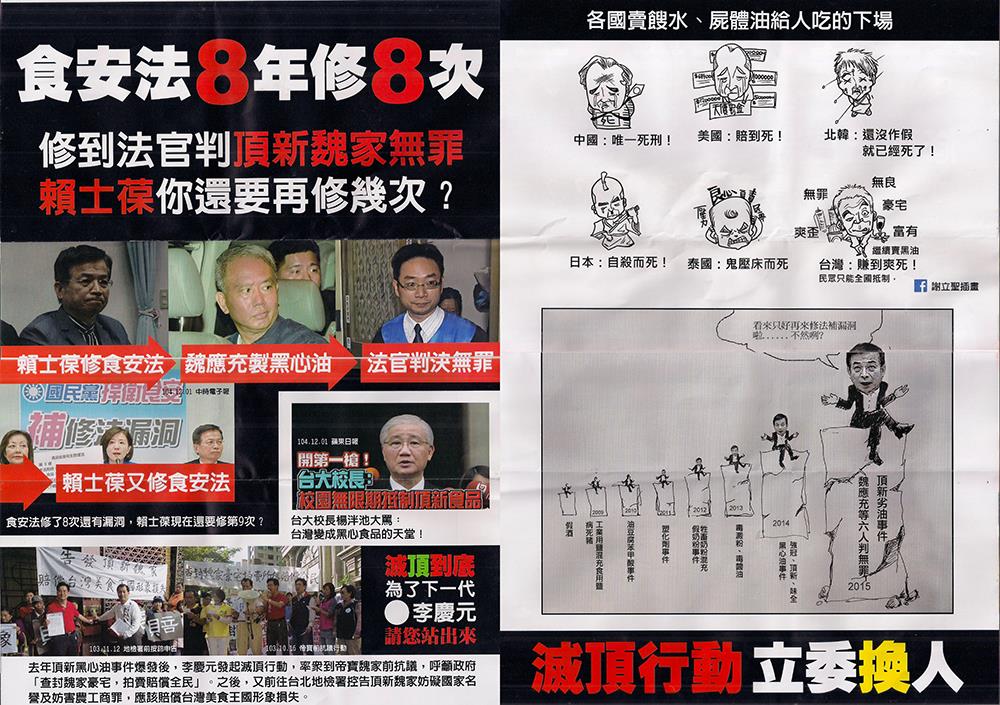
Meanwhile, in District 8, independent Lee Ching-yuan (whose KMT membership was revoked in July due to his opposition to then KMT presidential candidate Hung Hsiu-chu) is gunning for incumbent legislator Lai Shih-bao. He’s released two leaflets with the intention of smearing Lai, both on the basis of whether he’s actually living in the district and his alleged incompetence in dealing with food-safety issues surrounding the Ting Hsin oil scandal.
The first leaflet attacking Lai on the Ting Hsin scandal is below:
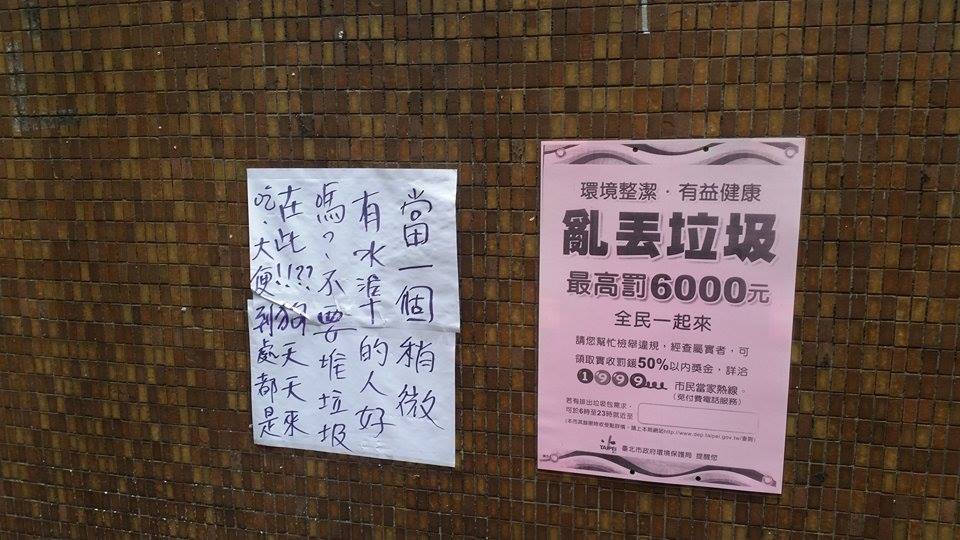
Following on from my past post on the passive aggression that results from the limited parking spaces in Taipei, I thought I’d follow up with a similar post about rubbish, after seeing this sign, on a street in the Daan district of Taipei:
If you live in Taipei you’ve probably seen a whole heap of signs similar to this, but the hysterical tone and the interesting use of punctuation of this particular one made it stand out for me. It reads:
Can’t you have the least shred of decency? Don’t pile rubbish up here!!?? Dogs come here to eat it every day and there is shit everywhere.
If you don’t live in Taiwan you may be unfamiliar with the system. Basically, you have to buy special bags at convenience stores to put rubbish in, then at a certain time every day the rubbish trucks will come to the end of your street. Unlike in the UK, you


 If you’ve been in Taiwan for a substantial period of time but didn’t grow up here, chances are you’ve sat on the outskirts of an hilarious conversation involving characters from the books of martial arts novelist Jin Yong (also known as Louis Cha) during which you’ve had completely no idea what was going on, or what the jokes were about. This has been my fate on several occasions, as, although I’ve bought several volumes of Jin Yong’s novels, I’ve never mustered up the courage to commit to reading a whole one and they’re currently rotting on my shelves. Given that generations of teenagers in Taiwan have read most of the Jin Yong canon, there are a lot of mainstream cultural references that revolve around these books.


 I came across the (somewhat controversial) Taiwanese phrase for (non-Asian) foreigner 「阿凸仔」 in a