My note-writing neighbour (you can see their doctoral thesis here) has been at it again, although, to be fair, this doesn’t rank up there with their more passive-aggressive notes (although I would have appreciated a 「請」 thrown in there somewhere). I almost identified with them on this note, as it represents a phenomenon I often encounter when learning other languages, the tendency to assume that a specific usage of a multipurpose verb in your language can apply to all the usages of the verb in your target language, illustrated brilliantly below:
壞了,一直在閃、很危險、不要開。 Don’t drive.
Broken, it keeps flashing, it’s dangerous, don’t turn it on.
「開」 in Chinese means “to start” or “to turn on”, in conjunction with 「車」 it can also mean “to drive”. So I’m guessing they googled “不要開” and got “Don’t drive.” I guess the solution is to always search for the terms you Google translate to see if it matches the idea you were going for and is used commonly in the target language. The only example I can think of going the other way is the tendency of foreigners to use 「是」 for adjectival phrases in Chinese, 「我是熱」, for example, as an overly literal translation of “I am hot.” Can you think of any examples that fit the brief more accurately?
My neighbour clearly hasn’t been taking notes since I corrected their previous note which was either on door closures or dog euthanasia:
I liked this poem because it had something of a Ferris Bueller’s Day Off vibe to it and it serves as a necessary reminder that you can’t always play by the rules or take everything so seriously:
It feels like a return to
Eating ice-cream as students, your arm on my shoulder
Skipping one lousy class made us feel as if
The entire summer
Was stretched out by the duration of that one class, and we sensed deep inside
That this carefree hour had burnished our whole lives
Making them glisten more brightly
P.S. The poem is not a reference to 趴趴走ers, fleeing from quarantine (sorry did I ruin the mood by bringing up the dystopia that is our current reality?).
「奧步」 is the common written form for the Taiwanese expression 「漚步」 àupō͘ meaning a sly or crafty move. This is just one of those phrases you’ll hear again and again. I heard it a while ago in the run-up to the election:
「尤其是大家其實現在都在期待就是民進黨最後會出什麼奧步。」
“Especially when at the minute everyone is actually waiting to see what crafty maneuver the DPP will end up pulling at the last minute.”
You can hear it around the 11:04 point in the video below:
I heard it again just now while getting my hair cut (shorn off), in the Taiwanese soap opera 《炮仔聲》 (Ep 327) playing in the background. It was translated into Mandarin in the subtitles as 「耍手段」:
「這個江宏傑真的有夠可惡,只會耍手段,不是用錢收買人,就是抓人的親人來威脅。」
“That Kang Hong-kiat is a real piece of work, he’s always got some sly trick up his sleeve. If he isn’t buying people off, he’s using people’s families to threaten them.”
Earlier in the episode, one character describes getting a woman drunk in order to get her into bed (quite rightly) as an 「奧步」, although this time it’s translated into Mandarin as 「卑鄙手段」 “how could I use that kind of dirty tactic?”
It’s one of those really useful phrases that’s really hard to find the right situation to use. In the first example I used, it’s used in a Mandarin sentence, so you can use it that way too, but make sure your tones are on point if you’re going to, or you’ll stand there shamefacedly repeating yourself until you have to spell it out like I did in the kitchenette at work when I called my colleague a 抓耙仔 jiàu-pê-á/liàu-pê-á (a snitch). I said bei instead of pei or something *shrugs*.
These commemorative stamps (they can’t actually be used as postage stamps, they’re just decorative) were launched by the Taiwan Anti-Tuberculosis Association. The one with all the shrimps on it is their way of saying thank you to those who bought stamps in support of the cause.
Why does a bunch of shrimps mean thank you? 多蝦 duō xiā (many shrimps) is a transliteration of the Taiwanese for thank you to-siā (the actual characters are likely 「多謝」 which is how it is normally written).
So next time you’re in a taxi with a driver with a nice body but whose face has a “nice personality”, remember “many shrimp” and you can charm him by saying thanks the Taiwanese way.
Initially, I was quite excited by this book, as I’d previously watched a documentary by this late director (I reviewed it here). The book starts off with a moving account of the disintegration of the author’s family and the effect of his sister’s death on him and the larger family.
As the book develops, however, the same story is repeated ad nauseum and seemed almost like the author was trying to impose his own moral interpretation of his riches to rags story on the reader. The tone also seemed more appropriate to the essay format, rather than a long-form novel as he seemed to get a bit lost in his own narration after giving the broad strokes of the initial story. There are interesting aspects to the narrative. In the context of the gay marriage referendum, there has been a shift towards conservatism within the gay movement, and this has led to clashes within the movement, between those attempting to be inclusive to the extent of embracing what they call “chem sex culture” and BDSM fans and those in pursuit of (what their opponents would call) heteronormativity. The author seems pulled by these two conflicting strands of the gay community throughout, which may be what drives his switches between the first and third person at points throughout the book.
I’ve never really been a fan of autobiographies and towards the end of the book, it started to grate on my nerves a bit. The author teases the reader a little by suggesting he’s going to reveal the details of his life, but apart from brief references to a few of his relationships, a disjointed scene where we assume he’s having chem sex, the author’s main purpose throughout the novel seems to be to air the dirty laundry of the rest of his family members, while he maintains a Madonna-like status of victimhood throughout. There’s a lot of anger and resentment in the book, and this comes across in passive-aggressive comments and made the book come across as quite monotonous. Whereas in fictional works like Moonlight, there is a layer of separation between the author/director and the anger of the protagonist towards their family, the first person narrative here left us with nowhere to go, as the author doesn’t seem willing to reflect on the larger social context and systematic problems surrounding his family’s downfall in the same way that Moonlight tries to give the protagonist’s mother a human side.
We almost get to a scene comparable to the scene in Moonlight when the author faces his father’s mortality, but it doesn’t have the same impact for me as the film. Reading the book was almost like listening to someone you don’t know gossip about the people in their life, or someone showing you their family photo album. As a reader, I found it hard to care. Maybe due to the author’s familiarity with his family members, we’re never given a complete picture of them, just who they are as they relate to him, and, frequently, how they’ve victimized him. The central theme of the book is the tragedy that occurs in the author’s childhood. The tone flits between brief moments in which the author portrays something genuinely moving, snarky quips, boasting and wallowing in self-pity. While it’s nice that the author broke up the heaviness of the tragic portrayal of his sister’s death and his family’s disintegration, the other bits of the book felt a little posed, and there was a lot of name-dropping. Essentially they are there to show us what a famous, witty and high-performing luvvie the author is despite the loss of his sister and the break-up of his family home initiated by his father.
If I were to take a more cynical view on the change between the first and third person I mentioned above, it could be seen as an attempt to “be literary”. Combined with certain other comments throughout the book like “The small hole in the back of the intricate doll, now looking back, of course, was a massive symbol for leaving my carefree childhood”, just came across as pretentious attempts to sound educated. I felt this came across in a passage in which the author talks about drug-fueled sexual experiences at the Taiwan Youth Park, and he switches from the first to the third person, reflecting perhaps the disassociation that he feels from taking Ketamine:
It wasn’t until the Taiwan Youth Park became Taiwan’s gay beach that he understood how much earthly pleasure could be derived from a perfectly round asshole. In the shower rooms there were always seductive twinks, beckoning you over brazenly with their assholes, then after riding a motorcycle together and eating shaved ice with brown sugar from the shop beside Jianguo High School, it was time for the even sweeter treat of fucking them. Lots of pretty boys will remain frozen with their brow slightly furrowed in the childish expression that comes just before an orgasm on an IKEA sun lounger, their assholes suddenly tightening dramatically as I can’t stop myself cumming in that blurry world of K, I thought of the fragrant scent of afternoons on the moors from my English Literature classes. The boys would sigh gently in satisfaction and then cuddle against you to sleep, as you hold their youthful bodies, with their faint sweet smell, with the lingering whiffs of the leftover Rush adding to the mix, and as the smell hits the nostrils you fall into the naivete just like that of youth, and the past goes up in smoke.
As men age, the ongoing resplendent sexual history is never as sweet and innocent as the classical era. Perusing to a certain page, sexual experience with the smell of rush, on E and Foxy Methoxy (5-MEO-Dipt), implying each other’s guilt with the most complex of symbols in an iron corrugated book, it’s hard to replace the myriad momentary sensations of the penis, the asshole and the nipple. The world on a grain of sand, spreading out and blossoming everywhere. A flower blossoms from the asshole, the penis is an awesome tree. He felt his entire body had turned into an iron-clad book, with the age rings of sensation and the codes of whispered nothings. Whispering in my ear, the body is memory itself.
I liked the fact that he inserted an apparently random thought into a sexual experience, as it made it ring truer, but everything the author does seems aimed at proving his extensive learning, which is why the random thought is about his English Literature classes.
In another of the brief interludes where we get a glimpse of the author himself and not just his family, he talks about his sexual relationship with one of his long-term partners:
At night we always went to the rustic local showers. As soon as we locked the door Lao Luo and I would start passionately groping at each other. The soap suds flowed between our buttocks and around our erect cocks. Our army mates would knock impatiently on the door as Tony Leung from Happy Together spits as he enters Leslie Cheung, without any KY, without a condom. This was our diethyl ether-scented first memory, entranced with passion on a Summer evening, and it cuts through layer upon layer of memory to emerge again.
Some of the author’s comments on class are a bit over the top, particularly as he’s aware himself that he’s one generation away from a similar level of poverty. He’s constantly emphasizing how educated he is as a way to elevate himself:
That year, when Lao Luo and I had just gotten out of the army, I continued to teach English at a cram school, working hard to earn money to study abroad. He worked painting houses, and when he got off work he liked to go for a tipple, and play arcade and pachinko games with his friends. We had no friends in common and I hated the pack of scoundrels he hung out with, whereas he thought all my friends were from another planet. As soon as we started to argue, there was no buffer zone, there was noone to mediate, there was just the two of us clashing hard and going after each other. Young as we were, we didn’t understand that sometimes, no matter how deep the love you feel, it can’t cross the class divide.
One interesting aspect of the narrative is how the mainlander/local Taiwanese division functioned beside class divisions. His father’s family is local Taiwanese, which plays a large part in his father’s rags to riches story. The author’s paternal aunt marries a 「不愛講話的外省老芋仔」 (a taciturn mainlander), who is 30 years older than she is. Another of his paternal aunts manages to escape from a 「wife-beater」only to marry a butcher who starts another family on the other side of the Taiwan Strait. When she goes to confront her husband’s wife in China about this, the fight that results makes the local paper in Guangzhou and the author jokingly refers to it as 「為國爭光」(winning glory for one’s country). The author’s father is said to have a consistently patriarchal attitude to everything that befalls his sisters, even though they are often providing him money to provide him investment for his hair-brained get-rich-quick schemes and bail him out of financial trouble.
Overall, it’s worth a read, although it might wear on your nerves a bit. The author, also a director, passed away recently.
This is an unnecessarily complex way to convert your Google Play book to a Kindle readable version. Why don’t they make their systems interoperable? (Sigh!)
Go to Google Play Books:
Step 1: Click ‘My Books’
Step 2: Hover over the book you’ve bought in Google Play and click the ︙ button.
Step 3: Select download ePub and download it to your computer.
Step 5: Once you’ve setup an account, go to ‘File’ and ‘Add to Library’, then select the file you just downloaded and open it.
Step 6: Go back to Library
Step 7: Download Calibre (yes, you also really have to do this.)
Step 8: Download DeDRM Tools (shhh… just do it) and extract files.
Step 9: On the main screen of Calibre, go to Preferences, and then click Plugins, under the Advanced Tab.
Step 10: Click ‘Load Plugin from File’ and select the DeDRM Tools file you just downloaded and extracted.
Step 11: Restart Calibre and Click ‘Add Books’, and select the downloaded file from My Digital Editions
Step 12: Select ‘Convert Books’, and select MOBI as the output file type.
Step 13: On the right of the Calibre app there should be a Path: Click to open link. This will lead you to your newly created MOBI file, which you can transfer to your Kindle.
Step 14: You’ll generally have an email that you can send files to, or you can just do it the old fashioned way via USB.
Taiwan has been quite slow to get into the e-books game, but over the last few years, more and more titles are being made available on a range of platforms. Although there is a range of reading devices available, I’m going to look only at e-books available on the Kindle (the only dedicated e-reader device in my possession) and on various mobile phone apps.
A word of warning, expect to be slightly disappointed. The industry seems largely to be dragging its heels, preferring traditional paper copies to digital copies (cue a junior lecturer’s lesson plan on Walter Benjamin). I’m not sure if this has to do with copyright law or if there’s just a general fuddy-duddyness. Anecdotally speaking, I’ve seen a lot of people reading martial arts novels and lots of manga on their phones in the MRT.
Kindle: I was actually surprised when I was gearing up to do this blogpost, how many Taiwanese books are available on Kindle if you search for them. That is the catch though, you already have to know what you’re looking for. Once you do manage to get your book on to the Kindle, it works quite well.
The other options available that I’ve seen are Google Play Books, MyBooks or eBook – the eBook reader launched by books.com.tw (and there’s also ReadMoo and Kobo rated below in the table). Even here, older but famous titles (like 《孽子》 for example) are hard to find. If you know of any other stores let me know in the comments section.
For non-Apple users, the Easycard Wallet app can be used for everything from buying stuff with a virtual Easycard, renting YouBikes or beeping in and out of the MRT. See my previous post here!
If you’re going through the change (not the menopause, the shift to the new ARC format), you might wonder how to update to your various YouBike related apps to the new format.
First step is to take a photo of the front and back of your new ARC on your phone, so that you can upload when prompted.
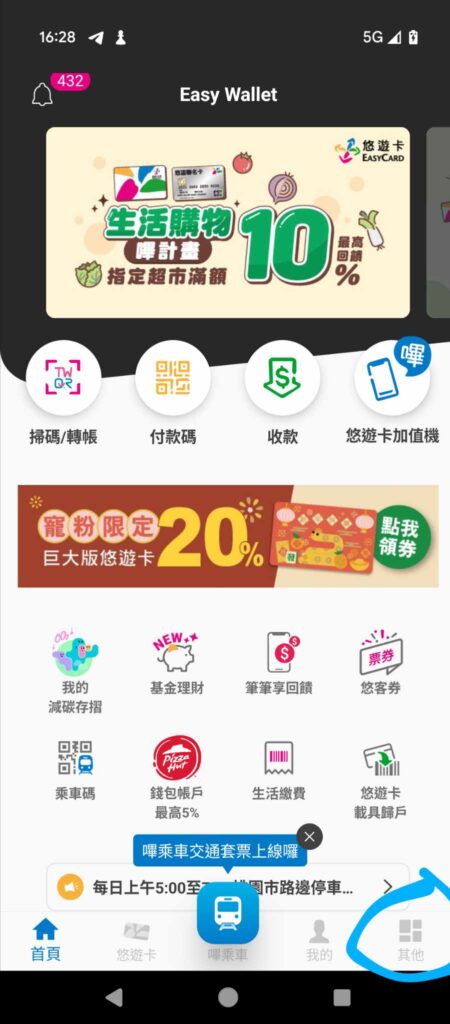
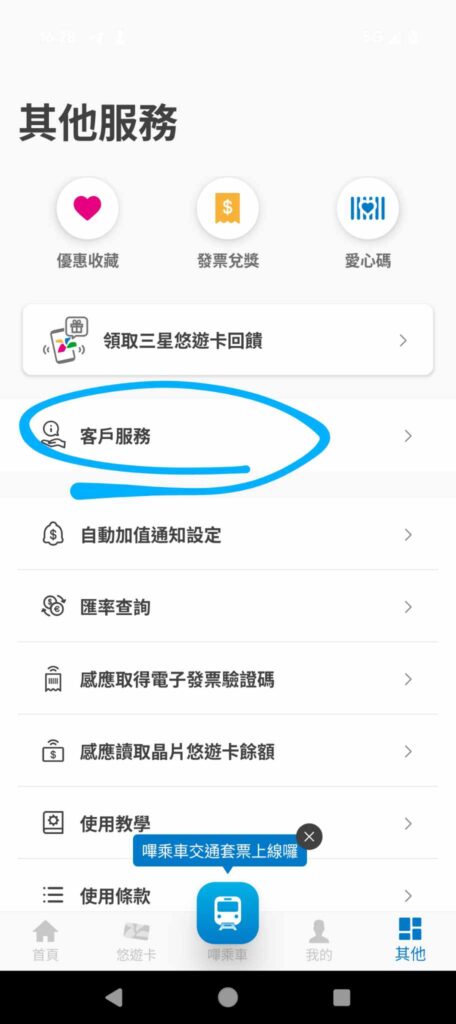
On the Easycard Wallet, hit the 其他 button on the bottom right:
Not an expert at this, but a commenter asked for a guide to using Family Mart to sell things. I’ve never sold on the platform, but thought I’d try and help out.
If you’re selling something, you’ll want to click on 賣家專區 (Seller Section) highlighted in red below:
You’ll get an error message and will be redirected to this page, prompting you to register/login. The page asks you to enter your phone number as below:
Once you enter it, they’ll send an SMS to your phone to prove you’re the owner of the phone, and then they’ll prompt you to set a password for your account.
Next up is this page:
This is easy enough, just fill in your account name (should be the name on your bank account), make sure you select 「外籍人士」 then fill in your ARC in the ID section, then select your bank, branch (your branch code is normally the first few numbers of your account no. for E Sun bank account holders) and fill in your account no.
The second bit of this page, is for those who want to be able to have credit card payments received on their behalf. So you can sign up for ECPay (綠界科技)for free if you want:
I’m not going to sign up for that for this demo, but partner banks are listed here.
After that you’ll get a message telling you to check your account name in case there are any errors, but there should be a follow-up message congratulating you for setting up a store. Then you’ll come to the personal information disclosure screen. It will ask for your name, your email (twice) and at the bottom it will ask you if you’re willing to disclose your personal information. (The first option is disclose individual info, the second is disclose company info and the third is don’t disclose – which will be highlighted in blue and is the default choice):
From here, you can add a store:
From here, you’ll be able to name your store:
Then you can list your products:
You’ll be prompted to fill in information about the product you wish to sell:
Once you sell something, I’m assuming you get follow-up instructions.
Anyway, that was for Sue, if you have any follow-up questions, feel free to write again.


 This is an unnecessarily complex way to convert your Google Play book to a Kindle readable version. Why don’t they make their systems interoperable? (Sigh!)