The Taiwanese language has a lot of imported words from Japanese, but one of the most common and fun is “Asaburo” (often transliterated into Chinese as 「阿薩布魯」) used to refer to something messy or chaotic. Like, for example in this article:
The early-warning radar deployed on Dongyin Island isn’t a hodge-podge of low-grade copper and shoddy tin, but is rather an AN/FPS-117 3-dimensional air search radar, like those watching over the northern and southern extremes of Taiwan from an altitude of over 1,000 meters above sea-level at the Songshan and Dahanshan radar stations.
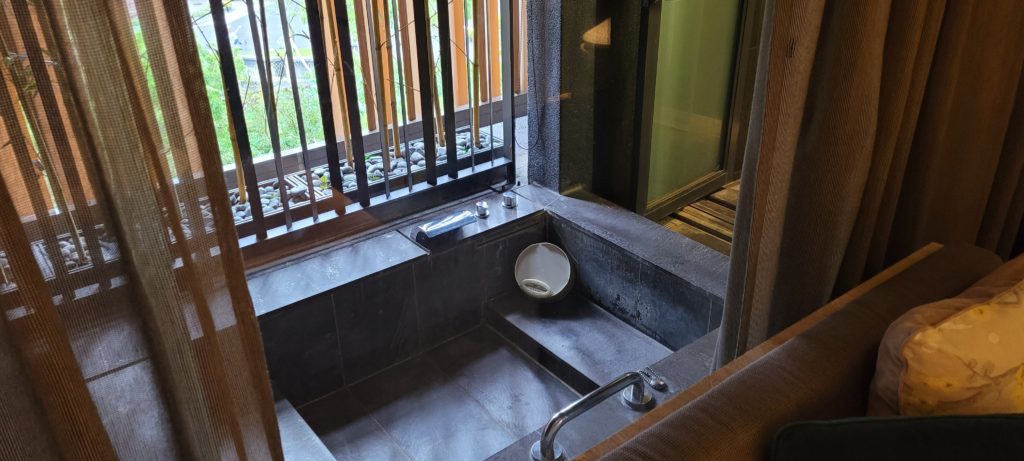
The funny thing about this word, however, is that in Japanese (朝風呂/あさぶろ/asaburo) it only refers to morning baths.
The running theory in Taiwan (and among my colleagues when I discussed it with them) is that this word was adopted to mean messy, as the idea of bathing in the morning is a messy thing to do. This touches on a bit of a cultural difference between Taiwan and the UK/Ireland as, although I remember having a bath every night before bed as a child, it was the norm for my entire family to shower in the morning before school/work once we were old enough to wash ourselves. In Taiwan, the general idea is that you should be clean when you go to bed, whereas in the UK/Ireland the general idea is that a shower in the morning wakes you up. If you’ve ever lived with a Taiwanese person, you’ll register their dismay if you choose to shower in the morning instead of before bed.
You can always shower twice a day, especially during the humid summers in Taiwan, to keep everyone happy.
I also found this list of Japanese imported words on the internet, if you want to broaden your vocabulary (unfortunately the blog has been deleted, so have used the wayback machine to find it):
Tones play an even more important role in Chinese than accurate pronunciation a lot of the time, but you know you’re swimming in the deep end when even native speakers have to clarify the difference.
One of my friends was talking about a colleague of theirs and said:
「XX很雷,跟他共事很累。」 “XX is a real liability, working with him is exhausting.”
When the person he was talking to appeared confused, another friend clarified 「地雷的雷」.
Literally “thunder,” or “landmine” in the context of 「地雷」, 「雷」lei2 is an adjective used to describe someone as clumsy or always mucking things up. My friend made a real effort to emphasize that it was second tone, to distinguish it from 「累」 lei4 (tiring/tired).
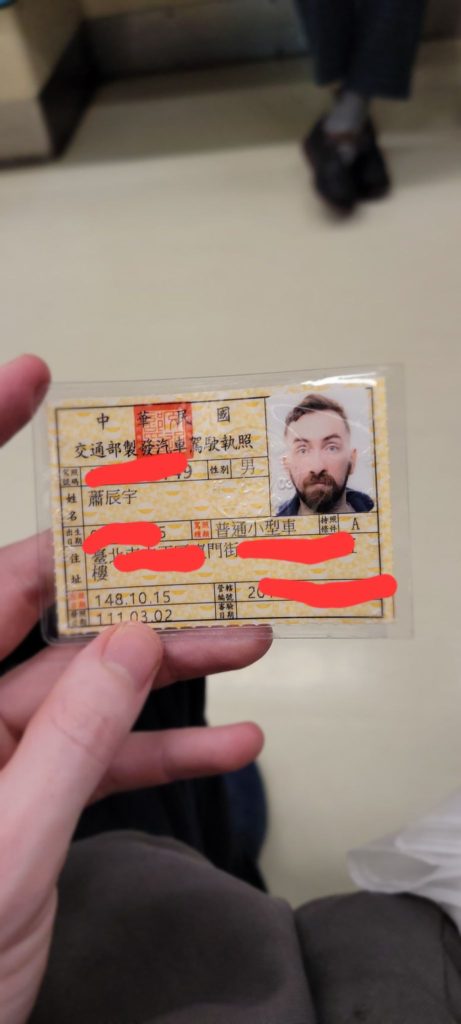
As I’m from Belfast, I thought that I’d have some difficulty swapping my license under the UK-Taiwan license exchange program. I did have to do some extra explaining but was able to swap successfully.
The initial announcement of the scheme when the memorandum of understanding was signed specified that Northern Irish licenses were excluded, but when the scheme launched in January of this year, no such exclusion was mentioned in the description of the scheme. I messaged the British Office, and they said they had no idea and told me to ask the Taiwanese Motor Vehicle Office. They were a bit more helpful and said that the agreement specified that it was the entire UK (which, of course, includes Northern Ireland).
If you’re from any part of the UK except for Northern Ireland, you can use the gov.uk system to create a check code for your license (used by the British Office to verify your license). If you’re from Northern Ireland, your license number won’t fit, however, and you have to use the NI direct system to create a check code (you have to create an account and apply to upload info on your license, but it’s reasonably simple). I created my check code (to be used within 21 days of creation) and printed out the docs.
I set off to the Taipei Motor Vehicles Office (臺北市區監理所) in Songshan District (about 10 minutes walk from Nanjing Sanmin MRT Station), but you can go to any office. When you arrive, you will have to proceed to the 2nd floor and hit the ticket machine for driver’s licenses.
Checklist:
Passport
ARC valid for at least six months
UK driver’s license
Check code
2 x Driver License (1 inch) photographs (there is a photo booth at the office)
NIA Certificate of Entry and Exit dates (Note: I didn’t bring this and they didn’t ask, but it’s listed by the British Office – link below)
The staff didn’t know what to do with the NI Direct check code, as they’d only been instructed to use the gov.uk system. So the woman came out and discussed it with me and I told her that Northern Ireland has a different agency and a different system and she said she would check with the British Office and get back to me.
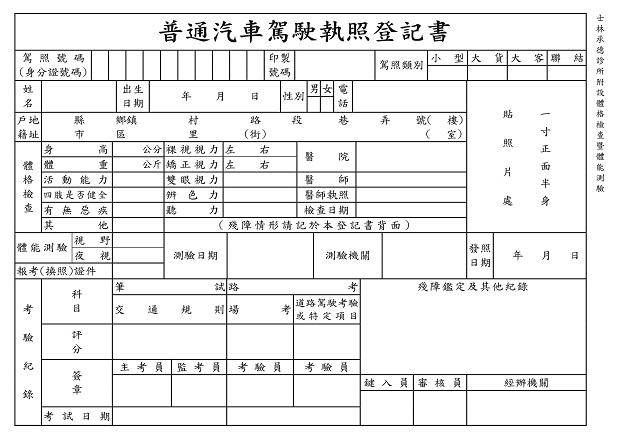
You don’t have to hand in your health check until you are contacted and your check code has been authenticated, but it’s quite convenient to do it the same day at the nearby Po Jengh Hospital (博仁綜合醫院). While you’re handing in your license info and check code, you can ask for the following form to do your health check:
Go to the main door of the hospital and tell the security guard that you want to do a driver license health check (駕照體檢/jiàzhào tǐjiǎn). He’ll stamp your hand with a blue “P” and tell you to go into an alley and go in a side entrance on the left. This is the special entrance for health checks. You take the elevator up and then take a ticket and wait for the various checks (it took me around 20-30 mins). Remember to take NT$300 in cash to pay for the health check. They check your hearing and sight and a few other basic checks. After you pay, you have to take the health check certificate back down to the main lobby of the hospital to get stamped (you don’t have to take a number, there should be a lady sitting to the left who deals with your form).
You don’t have to hand the health certificate in that day and can just wait for the office to contact you. They were pretty quick for me, I did it on the Friday before the 228 bridge weekend and got notified it was authenticated on the following Tuesday. I went back to the Motor Vehicle Office with my passport, ARC, my driver’s license, the health check and driver license photos (these have to be the same as the one you put on your health check form.
When you go back to the office, specify that it’s your second visit and they’ll go looking for your info. Then after a bit of staring at your ARC, passport and license (approx. 15 mins) they’ll hand you your Taiwanese license and take away your UK license (you can get this back if you return to the UK and return the Taiwanese license to the DVLA).