How do you say we’re fixing the road surface in fancy? 「路面銑鋪」

I came across these spray-painted messages on the road on the way to my local 7-11 last night. Messages sprayed on to the street are common in Taiwan, and they can be written by car/motorbike tow trucks telling people what number to call to get their vehicle back or construction companies or the city government telling people not to park in the street as construction is about to take place.
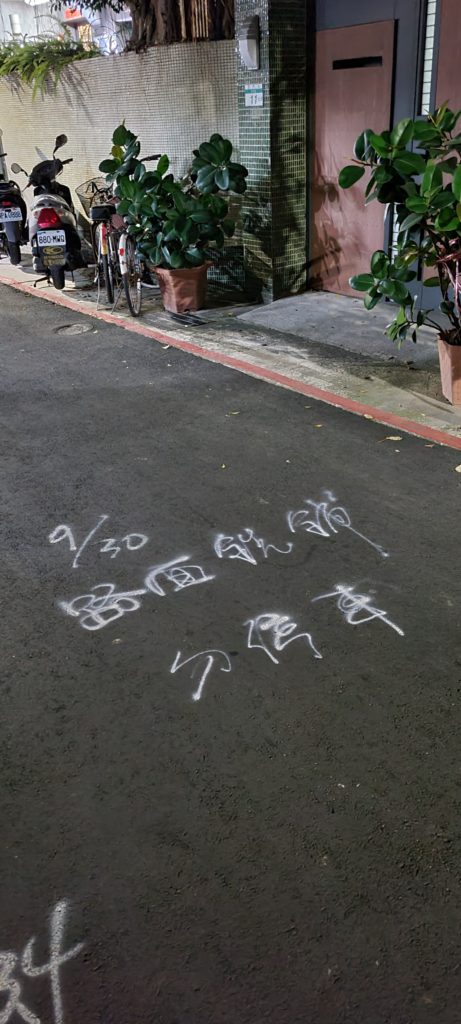
I could see that it said 「路面xx勿停車」 (“road surface XX, don’t park), but I was a little puzzled by the third and fourth characters, as they both looked like they had 「金」 as radicals. I assumed that as they were repaving the road, it’s likely that the second one was 「鋪」 (to pave), but I’d never seen the character 「銑」 before. So I wandered down the street a bit further to see another of the messages:
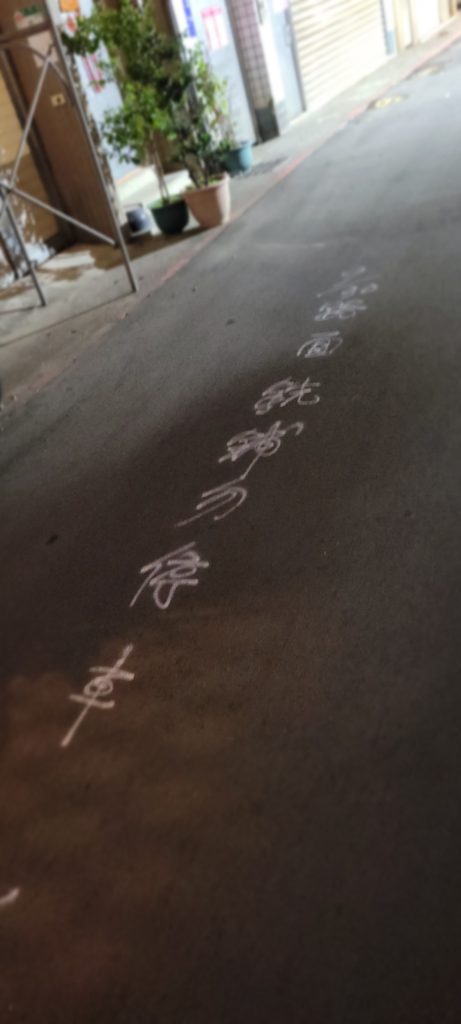
The 「鋪」 was a bit clearer in this pic, so I tried to look up the characters 「銑鋪」 (xiǎnpū), and came across this old video from the China Times, suggesting that I wasn’t the only one to be puzzled:

According to this video, the original meaning of 「銑」, milling, has been extended here, to mean “to roll flat/steamroll.” It seems to be a more technical way of referring to resurfacing roads, but a more common and colloquial way to say this is 「路面翻修」 (lùmiàn fānxiū).
Passive Aggressive Notes: Neighbourly Nagging to Assert Dominance

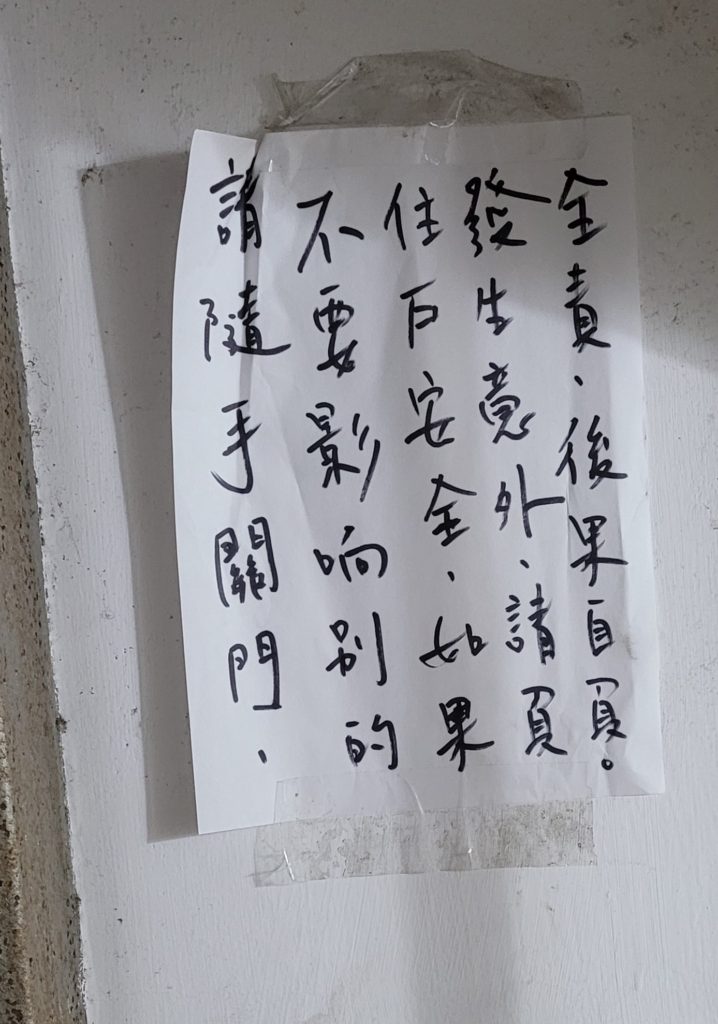
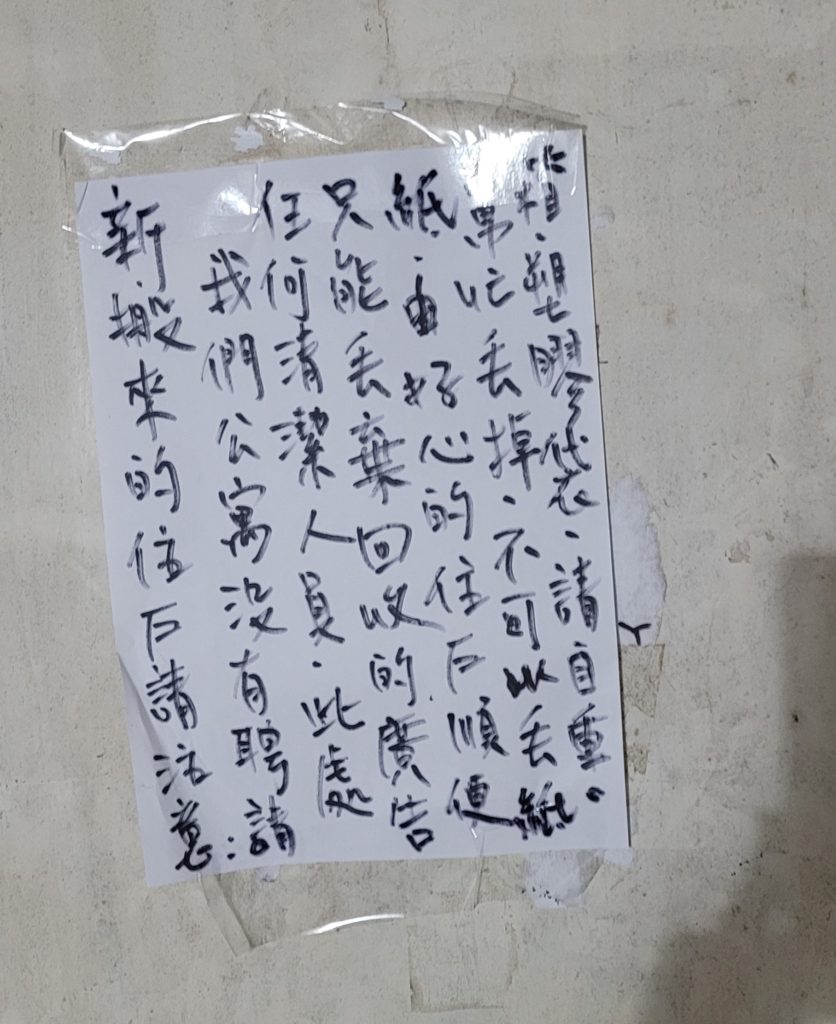
As I’ve mentioned before, one of my neighbours is a prolific note writer who comes up with all sorts of imagined scenarios, from axe-wielding maniacs sneaking into the building to accusing people of chucking tapioca onto their awning and calling the fire brigade when anyone in a 400m radius lights a candle. A new neighbour has moved into the building, so the note writer has decided to show them who is boss, with these beautiful scrawls:

Despite their previous anger at people closing the door too loudly, the neighbour in question is continuing their tirade on the risks of the door ever being open at all. The new neighbour doesn’t have a buzzer, so has to come down the stairs every time they order food or (heaven forbid) have friends coming round.

請隨手關門,不要影响(響)別的住戶安全,如果發生意外,請負全責,後果自負。

Please close the door after you, so as not to affect the safety of other residents. If an incident happens, please take full responsibility. You’ll have to face the consequences.

One thing to notice is the abbreviation of the character 「 響」 to 「响」, the simplified character, which goes to show how often the more complex characters are abbreviated in Taiwan. One note is never enough though:

新搬來的住戶請注意我們公寓沒有聘請任何清潔人員。此處只能丟棄回收廣告紙,由好心住戶順便幫忙丟掉,不可以丟紙箱、塑膠袋、請自重。

The new tenant should be aware that our apartment block hasn’t hired any cleaning staff. Here you can only throw away recycled advertising leaflets, which one kind-hearted resident [clearly a self-reference] helps to throw away. It is not permitted to throw away cardboard boxes or plastic bags here. Please behave with more decorum.

How Do I Register for the Quintuple Stimulus Vouchers

If your online banking is crashing today, it’s likely because the Executive Yuan has released NT$5,000 stimulus vouchers starting today and banks are making a ream of offers to early birds.

If you’ve got an APRC or are a Taiwanese citizen with household registration and a bit of patience, you can get them by navigating to the dedicated website here or the English version here.

There are four options:

  1. You can wait until to book the paper version in advance:
    First round advance booking: September 25 – October 1
    First round withdrawal: October 8 – October 21
    Second round advance booking: October 25 – November 1
    Second round withdrawal: November 8 – November 21
  2. You can register to tie the vouchers to your credit card.
  3. You tie them to Easycard style cards (like Ipass etc)
  4. You can tie them to a digital wallet, like Taiwan Pay, etc

Currently, the website is patchy as it’s getting a lot of hits, so it’s best to go through your bank or payment method of choice, which all feature prominent links.

I chose to tie mine to Taiwan Pay through the Megabank app. Most banks have a simple enough interface to navigate but don’t give up if they throw up an error message, as everyone is rushing on the first day.

If you’ve panicked and want to check exactly what you’ve registered for, you can use this function to check your status.

The advantage of using digital versions, is that there are often additional offers. The downside, as I’ve mentioned before, is that you don’t get to brag on Instagram.

There are additional bonuses you can accrue, depending on which bank or payment app you tie your vouchers to:

Taiwan Pay is offering additional funds to a certain number of registrants.
ESun is offering NT$50 for single registrants, but you can increase this by registering as a group.

Note: the spending period for the vouchers starts October 8!

For Taiwan Pay, the first period of payment runs from October 8-22, which is when they’ll calculate what bonuses you get back. This will be deposited in your account November 1. Then the second spending period runs from October 23-29 and the kickbacks will be deposited into your account on November 8. The third spending period runs from October 30 – November 5, and the kickbacks are deposited on November 15.

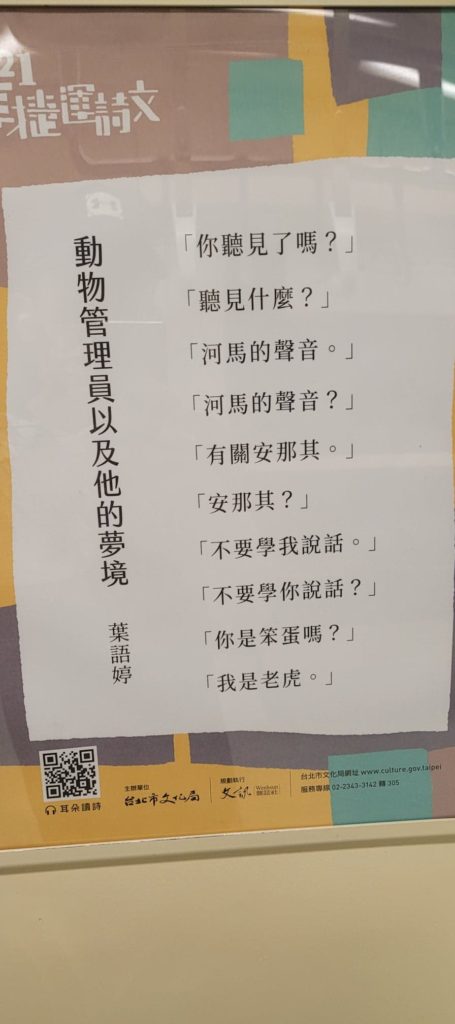
‘The Animal Manager and his Dreamscape’ by Ye Yu-ting

動物管理員和他的夢境

「你聽見了嗎?」

「聽見什麼?」

「河馬的聲音。」

「河馬的聲音?」

「有關安那其。」

「安那其?」

「不要學我說話。」

「不要學你說話?」

「你是笨蛋嗎?」

「我是老虎。」

The Animal Manager and His Dreamscape

“Did you hear that?”

“Hear what?”

“The sound of a hippo

“The voice of a hippo?”

“Concerning anarchy.”

“Anarchy?”

“Stop repeating everything I say.”

“Stop repeating what you say?”

“Are you stupid?”

“I’m a tiger.”

I liked the Wu Ming-yi-style magical realism conjured up by the title of this poem, however, the non-sequiturs kind of threw me off and I didn’t really vibe with the discussion between the disembodied voices. It’s possible I’m missing something in the interpretation of the poem and welcome any alternates in the comments section. I have to say that I’m not really a fan of Under Milk Wood-style stream-of-consciousness poetry that relies on dreams.

Ye Yu-ting has published two volumes of poetry, the self-published A Père David’s deer in peppermint-colored sleep (一隻麋鹿在薄荷色的睡眠裡) and The Invisibility in the Details (鉅細靡遺的透明) which was illustrated by Shiho So (a Taiwanese illustrator living in Tokyo). Ye graduated from the Chinese masters program of National Central University in Taiwan, where she headed up a poetry society. She has been the recipient of the Ye-Hung Female Poetry Prize and the Council for Cultural Affairs (now Ministry of Culture) poetry prize. For more information, you can see a profile of her here.