Passive Aggressive Notes – Raincoat Thief 雨衣小偷

19749349_10103376947868179_705298898_o

A note posted by a busy intersection in Dingxi

你拿走義交  You took away the volunteer transport guard’s
雨衣 raincoat
請還回來吧 Please return it, OK?

I saw this note a while ago, and it remained there for a good few days during the early summer rains. It conjured up an image in my mind of the poor transport guard’s face when he discovered it missing just as the rain was coming on but you have to admire his trust in his fellow citizens that it would be returned if he stuck this note up.

Foxconn’s Restaurant Chain? Trademark Hijacking and the Likelihood of Confusion 「鴻海燒鵝燒臘」

111223

It may be unlikely to cause confusion, but this Hong Kong restaurant, reportedly run by a Hong Kong couple, has used 「鴻海」(Hónghǎi ㄏㄨㄥˊ ㄏㄞˇ) , the first two characters of the Chinese name of Hon Hai Precision Instruments (known by its trading name Foxconn in China) in its name, 鴻海燒鵝燒臘 (Hong Hai Roast Goose Siu Laap). Hon Hai has a trademark, but has not filed for restaurants. Previously a cement company with the name Hong Hai also held a trademark for the same two characters, but it expired in 1981 and has not been renewed.

HonHai

Hon Hai Precision Instrument’s trademark


The restaurant was previously called 「香泰烤味」according to the review linked to above. So the decision to change the name was clearly a deliberate choice. However, it is doubtful that many Taiwanese customers would think that Hon Hai, which is one of the biggest original equipment manufacturers for Apple, has decided to branch out into reasonably priced Hong Kong-style restaurants. In an era where corporations have many different business units, however, it’s unclear as to whether this restaurant would benefit (of suffer) due to Hon Hai’s reputation.

The characters 「鴻海」 mean  ‘large ocean’.


Pro-unification Signs in Ximen 西門町統一分子

17373340_10103176578599799_669558543_o

This old man holding a People’s Republic of China flag is standing next to a sign reading:

「打倒日本侵略者,南京大屠殺罪惡」 “Overturn the Japanese invaders, and the evil of the Nanjing Massacre”

[wpvideo oEpbm1sq]

This video features several posters featuring the following messages:
「反對台獨,反對戰爭,台灣要和平,不願子女當炮灰」 “Oppose Taiwanese Independence, Oppose War. Taiwan should be in peace, so that our sons and daughters don’t become cannon fodder”
「什麼叫作92共識?92共識便是体現咱們都是中國人的意思。蔡英文是日本人嗎?蔡英文為什麼不承認92共識拖累我們?」
What is the 1992 Consensus? The 1992 Consensus embodies the idea that we are all Chinese. Is Tsai Ing-wen Japanese? Why does Tsai Ing-wen hold us back by not acknowledging the 1992 Consensus.
This is the spot where Taiwanese Independence activists gathered each week when the Kuomintang were in power.
Nearby here were the Falungong protesters, with posters and broadcasts calling for the arrest of former People’s Republic of China president Jiang Zemin for presiding over policies which purportedly allow for the harvesting of organs from political prisoners whilst still alive:
17431728_10103176793898339_340335144_o
These guys have invested in an English translation however:
17431728_10103176793898339_340335144_o
The sign on the left says “Bring Jiang Zemin to Justice” and on the right you can see
“Stop the Chinese Communist Party from violently harvesting organs from live donors”.

Variant radicals on parade with the Tudigong: 「蹺境/遶境/繞境」

17121543_10103143787708009_78872901_o

I saw this notice stuck on a traffic light from the bus this morning.

These notices are stuck along lamp posts and walls when a temple parade is going to pass by this area. As well as including the blessings 「國泰民安」(a secure country and safety for the people), 「合境平安」(Peace for everyone and everything), 「風調雨順」(No rain or wind) and a fourth I can’t quite make out 「? 去? 千 ?」, the basic information is listed:

「店仔街福德宮

福德正神謹訂於

農曆106年2月2日9時

國曆106年2月27日9時

境、出巡 」

Dianzai Street (lit. Vendor Street) God of the Earth Temple Notice

The God of the Earth (also known by the name Tudigong, but here Fudezhengshen) is set

on the 2nd day of the 2nd month of the 106th year (sic.) of the lunar calendar

on the 2nd day of the 2nd month of the 106th year of the Republic of China

to tour the streets on inspection.

What should be noted here, is that according to the lunar calendar, this is the 丁酉 year, not the 106th year (a borrowing from the National calendar).

There’s also what I think is probably either a mistake, or an attempt to render the notice in Taiwanese, with the use of the character 「蹺」 (qiao1) instead of 「遶」 or 「繞」 (both variants of each other) in the phrase 「繞境」。

A quick Google search can confirm that it was probably a mistake, as there are only 1,390 results for 「蹺境」 overall, and only one result in a news search. Whereas 「遶境」 produces 515,000 results overall, and 85,200 results in a news search, and 「繞境」 produces 423,000 results overall, and 17,700 results in a news search.

Year of the Rooster Couplets

Here’s a few couplets and Chinese New Year decorations from around my neighbourhood:

16389031_10103093264312299_1009185273_o

「心靜自得詩書味,室雅時開翰墨香」 “With a steady heart, finding joy by oneself in poetry and scholarship, one can smell the ink and brush in the elegant surroundings.”

16444116_10103093264536849_942580565_o

「修雙慧福」、「修福粒米藏日月,持慧亳芒有乾坤」
“Cultivating both wisdom and merit”, “By cultivating merit, a grain of rice can block the sun and the moon, by cultivating wisdom, the tiniest hair can hold the universe”

Incidentally, this has been announced as the official slogan of 2017 by Tzu Chi (慈濟), one of the most renowned Buddhist organizations and charities in Taiwan.

16409307_10103093264526869_799122283_o16409307_10103093264526869_799122283_o.jpg

「丁酉年
爆竹千聲歌盛世,金雞報喜唱豐年
靈昱秀
刻印」

Continue reading

The Monotony of Poverty: ‘Return to Burma’ Review 《歸來的人》影評

16443195_10155021845243593_1194554950_o.png
KTV; Source: Return to Burma

For me this film doesn’t work for completely the opposite reason that another film by this director, Ice Poison, didn’t work. Whereas Ice Poison is centred around the rather hackneyed trope of “young man led astray by damaged young girl”, this film is rather unclear in its voice and direction.

The film is underlaid with a pseudo-neo-colonial gaze, as much of it is pure exposition aimed at a Taiwanese audience, what people earn in relation to wages in Taiwan, what the different smuggled Chinese imports cost etc. This is not an unworthy goal, given that South East Asian workers are reported to have faced substantial discrimination and exploitation when employed in Taiwan and China, but I’m not sure if this makes the film interesting beyond its Taiwanese context. Otherwise the kind of poverty that they suffer, although awful, is rather unexceptional: the struggle to find work and support oneself and one’s family.

16409084_10103092008977999_162395807_o.png
Temple; Source: Return to Burma

Not much happens in the film and I felt that, although the director might be aspiring to capture the fatalistic outlook of the characters in Hou Hsiao-hsien’s films in the face of tragedy, the tragedies seemed too distant from the core of the film to give the impassivity of the protagonist any gravity in contrast. We hear his sister was kidnapped and forced to marry an older Chinese man, but she’s resigned herself to her circumstances and is wealthier than the rest of her family now, with two kids that she loves (interestingly Ice Poison shows us a woman who makes a different choice, in that she runs away from her husband in China and, long story short, she ends up in jail for drug-dealing (moral lesson: stay with your kidnapper?)). While I might criticize that sentiment, it underlines the desperate poverty of many of the people featured in his films. It’s also a common trope in the Chinese anti-modernist tradition, in which writers like Shen Cong-wen suggested that though tradition might seem overly exploitative or repressive of a certain group or class (i.e. women), the discretionary power inherent in traditional social relations tended to mitigate this harshness in everyday practice and that “modernity” could actually be more repressive in its lack of this discretionary power (see his short story 〈蕭蕭〉).

There is no real exploration of the political state of Myanmar (Burma) in the film (it occurs in the run-up to substantial political change) and the regime is largely invisible, other than the rather amusing pro-government songs that play, praising the new congress and a vague reference to strict anti-smuggling measures. This in a way reinforces the neo-colonial idea that the film is aimed solely at creating “Taiwanese guilt” for the way they take advantage of this poverty, which, although it may have some merit, doesn’t do anything to address any of the domestic causes of this poverty. Nor is there any exploration of the ethnic conflicts that have surfaced in the country over the last decades. This means that the telling of this story of poverty is so universal, that it would have had to take a more interesting narrative line or adopted a more interesting technique to keep it from being a rather monotonous retelling of what we’ve all heard before. I almost feel that Ice Poison was an attempt at breaking from this monotony by staging a romance, it’s just a pity that it felt so… staged.

Passive Aggressive Notes: Poop Drawings and Urine Variants

15991581_10103047511895509_1082074545_o.jpg

Another passive aggressive note that reads as follows:

街坊鄰居您好:

  • 這附近很少有流浪犬,卻常在巷口這一帶見到狗狗的[drawing of pool of dog piss]和 💩。
  • 請想想出入踩到的人心情有多差…😞
  • 煩請發揮公德心&飼主之義務,勿放任家犬便溺卻不清理!

非常感謝! Thanks a lot!!

[Translation]

Dear block neighbours:

  • There are very few stray dogs around here, but I often find doggy and [drawing of pool of dog piss] and 💩 around the mouth of the alley.
  • Think of how this affects the mood of people who step on it when they come in or out… 😞
  • Please have some common decency & take responsibility as a pet owner, don’t let your pet dog defecate and urinate without cleaning it up!

THANKS A LOT!

The friendly tone of the note, but insistent use of emojis qualify it as passive aggressive.

Also interesting is the use of the character 「溺」(here niao4/ㄋㄧㄠˋ) as a variant for 「尿」

Stealing power from the New Power Party – trademark battle

%e6%99%82%e4%bb%a3%e5%8a%9b%e9%87%8f%e7%ab%8b%e5%a7%94%e5%8f%83%e9%81%b8%e4%ba%ba%e9%bb%83%e5%9c%8b%e6%98%8c%e7%ad%89%e4%ba%ba%e8%b5%b4%e5%87%b1%e9%81%93%e6%8a%97%e8%ad%b0

New Power Party chair Huang Kuo-chang marching on Ketagalan Boulevard in protest against a meeting between former Taiwanese president Ma Ying-jeou and Xi Jin-ping; NPP legislator and rock star Freddy Lim can be holding the banner behind him; Licensed under Creative Commons by 蕭長展 – https://musou.tw/focuses/1040

An article in the Oriental Daily News drew my attention to something I thought was quite amusing – a man called Wang Chao-an (王朝安), who reportedly has no relation to the New Power Party has trademarked their party emblem for use on a whole range of products, including clothing, backpacks, stationary and jewelry products, such as earrings, necktie pins and key-rings. He applied for the registration in May of 2016.

The registration with the trademark office is as below:

shidaililiang

While the party emblem is a strikingly similar rendering of the character “力” meaning “power” or “strength”

partyemblem

The party intend to make a request for the registration to be cancelled with the trademark office through their lawyer, according to the report.

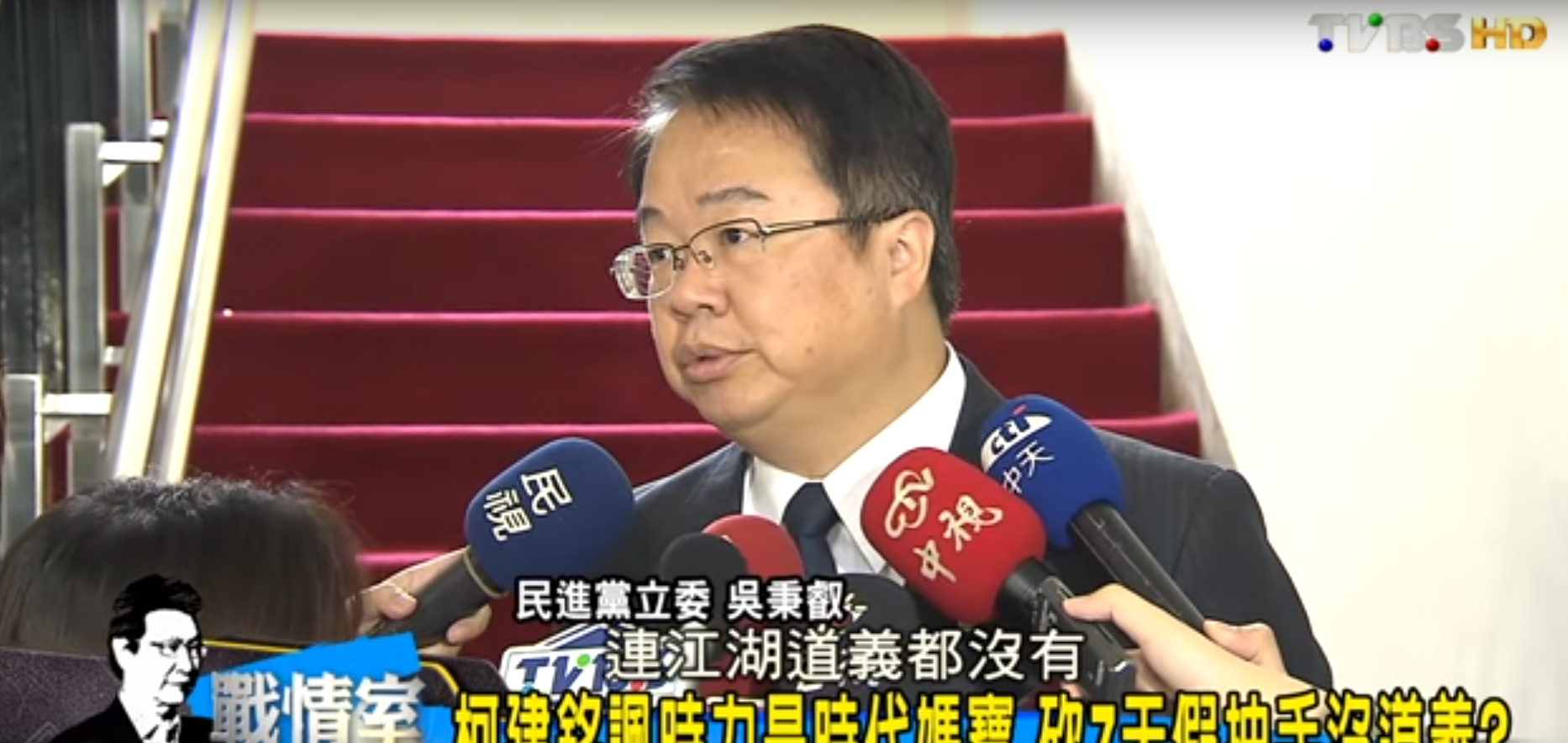
Honor Among Thieves? DPP Legislator Wu Bing-rui on the New Power Party 「連江湖道義都無」

WuBingRui.pngI thought this clip from Democratic Progressve Party legislator Wu Bing-rui (吳秉叡) talking about New Power Party legislator Huang Kuo-chang (黃國昌)was quite amusing. Huang backed out of signing an agreement on the 7 day holiday bill and insisted on changing the language from “completed examination (of the bill)” to “examination”, supposedly due to pressure from labor groups, much to the chagrin of the majority leader of the Legislative Yuan Ke Chien-ming (柯建銘). Ke then called Huang a 「媽寶」 or “mummy’s boy”. The change in the language doesn’t really do much to the content of the bill, as it has the same effect with or without the word “completed”. Wu has taken a lot of flak for his defiant response to protests by labor groups.

In the video Wu uses Taiwanese to state:

江湖道義都無 kang-ôtō   to   (Mandarin: 連湖湖道義都沒有)

Without even the Jianghu honor code/Without even the honor code of the mafia

This is the same as in Mandarin. Jianghu can refer to the community of martial artists in martial arts fiction novels or alternatively to the mafia. So essentially Wu is saying that the New Power Party don’t even have the honor code of the mafia. I thought this was a bit of a gaffe, given that it unintentionally implies that the DPP functions with an honor code like that of the mafia, hardly a comparison they really want to be making at this point.

MRT Prose: ‘You Can’t Drive into Taipei City’ by Hsieh Kai-te 謝凱特的「開車進不了臺北城」

15045297_10102918536273689_2006971619_o

開車進不了臺北城                                 謝凱特

那一瞬間,我想起父親背著一袋沉重的家私,裡頭裝著電鑽、鐵鎚等數不清叫不出名字的工具,受雇於出錢的資方,看建築師的藍圖,聽工頭的指揮,把臺北蓋出一座城之後,他像那些風雨烈日下吹曬刻虛的鷹架和綠色圍籬一樣,直至功成身退,訕訕退出城外,讓這些光鮮亮麗的符號進駐城中。

是他蓋起這座城,又被城阻擋在外。

You Can’t Drive Into Taipei City    by Hsieh Kai-te

In that instant, I thought of my father carrying a big bag of his things on his back, with his electric drill, his hammer and countless other tools I don’t even know the name of inside. Under contract from the moneyed classes to build the city of Taipei, he consulted the architect’s blueprint and listened to the instructions of the foreman, before, just like the scaffolding and walls of plants from the building site, weathered by the wind and rain then scorched by the sun until hollowed out, he returns to obscurity, sheepishly withdrawing from the city, allowing these symbols of grandeur to establish themselves there.

It was he who built this city, but he who is held beyond its limits.

節錄自《第18屆臺北文學獎得獎作品集》

This kind of prose always repels me to some extent, although I admire the imagery of the scaffolding. One reason for this is because I always think that overtly political art (with the possible exception of newspaper cartoons) generally comes across as preachy and tends to oversimplify nuanced issues. This was also one of the reasons I really didn’t like a lot of the work of theatre director Wang Molin. Another reason is that it echoes a lot of the political rhetoric of trade unionists and implies a sense of unpaid debt to the imaginary working class builders, mechanics and plumbers that pepper the speeches of Conservative politicians when they’re trying to incite anger against immigrants or intellectuals. The subtext to this is an implication that newcomers to the city and non-working class people are being rewarded at the expense of working class people. This kind of notion is often what feeds the xenophobia and inter-class resentment that featured heavily in both the Brexit referendum campaigns and in the recent US election campaign by Donald Trump.

Despite this, I do have sympathy for the chip on the shoulder view of Taipei that many people from central and southern Taiwan have, as I had the same chip on my shoulder when visiting London from Belfast growing up. Lots of people in Taiwan call Taipei the 「天龍國」 and Taipei citizens 「天龍人」. This is a term suggesting that they are elitist and look down on others. It takes its origins in the term “World Nobles” (Japanese: 天竜人 Tenryūbito) from Japanese manga One Piece and literally means “Heavenly Dragon Folk”, snobby arrogant elites who serve as the world government in the manga.